
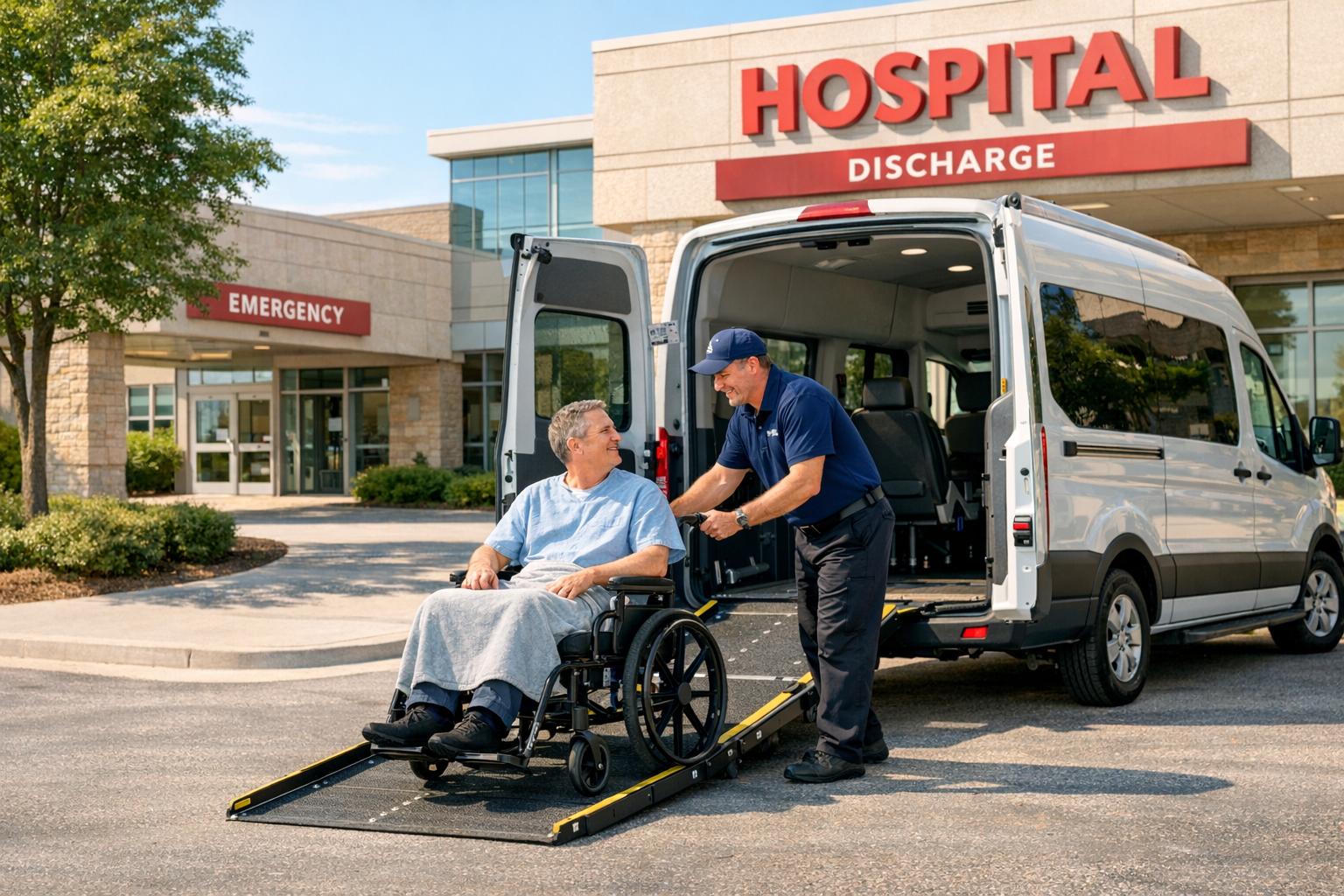
Getting discharged from the hospital in Austin can be stressful without proper transportation. Non-Emergency Medical Transportation (NEMT) offers a solution by providing safe, accessible rides for patients who can’t rely on standard options like taxis or rideshares. These services are designed specifically for individuals with mobility challenges, medical equipment needs, or those recovering from procedures.
Here’s why NEMT is essential for hospital discharges:
- Specialized vehicles: Wheelchair-accessible, stretcher-equipped, and ADA-compliant options.
- Trained drivers: Professionals skilled in patient care, including CPR and first aid.
- Time-saving for hospitals: Reduces delays, clears beds faster, and improves operational efficiency.
- Better patient outcomes: Ensures timely follow-ups and reduces risks of complications or readmissions.
In Austin, companies like Zyvra Mobility lead the way, offering tailored NEMT services with advanced scheduling tools, GPS tracking, and HIPAA-compliant practices. For hospitals, caregivers, and patients, NEMT bridges the gap between discharge and recovery at home, ensuring a smoother transition.
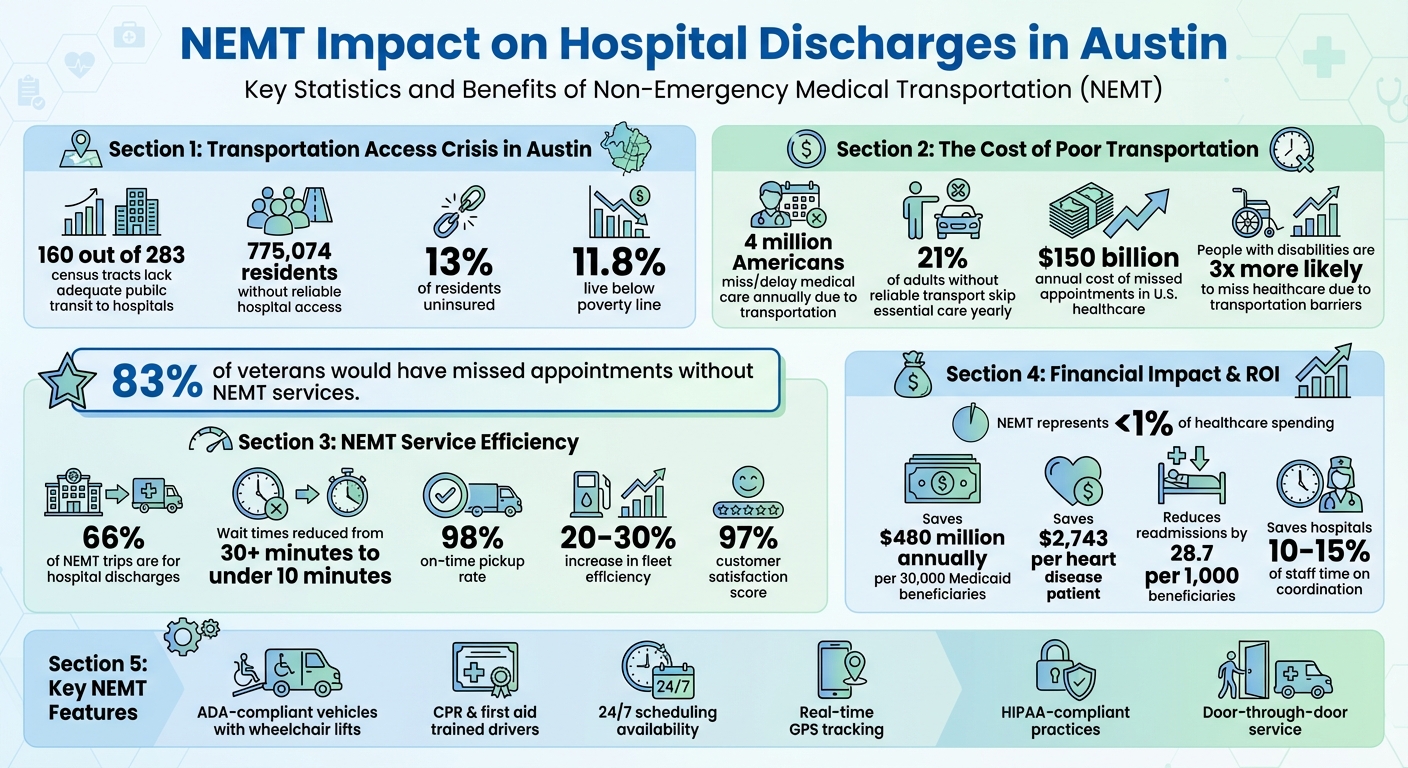
NEMT Impact on Hospital Discharges: Key Statistics and Benefits
Transportation Needs for Hospital Discharges
Common Discharge Transportation Problems
Leaving the hospital in Austin isn’t as easy as hailing a cab or booking a rideshare. Out of 283 census tracts in the city, a staggering 160 lack adequate public transit options to reach hospitals within a 60-minute window, leaving 775,074 residents without reliable access.
The issue isn’t just about distance. Many discharged patients require specialized transportation, like wheelchair-accessible vehicles, stretcher-equipped transport, or door-to-door assistance – services that standard taxis and rideshare apps typically don’t offer [4]. Coordinating these needs often falls on hospital staff, who must spend valuable time making multiple phone calls and navigating insurance details, leading to frustrating delays.
Austin’s demographics add another layer of complexity. Around 13% of residents are uninsured, and 11.8% live below the poverty line. For low-income families in areas like Eastern Austin, the lack of a personal vehicle combined with unreliable public transit makes it harder to attend follow-up appointments. Research by Smith et al. underscores this challenge:
Adults without access to a private vehicle, particularly those with low incomes or public health insurance, are significantly more likely to forgo needed healthcare due to barriers in public transit.
These obstacles make it clear: hospitals need better, patient-centered transportation options to ensure smoother transitions after discharge.
Risks of Poor Transportation Planning
When transportation plans fall apart, the effects ripple across the healthcare system. Each year, nearly 4 million Americans miss or delay medical care because they can’t find a reliable ride. Among adults without dependable transportation, 21% skip essential care within a year. For patients managing chronic conditions like diabetes or heart disease, missing follow-up visits can lead to severe complications and even emergency room visits.
Hospitals, too, bear the brunt of inadequate discharge transport. When patients cleared for discharge can’t leave due to transportation issues, it creates "bed blockage" – a situation where beds remain occupied unnecessarily. This reduces availability for incoming patients, increases hospital stays, and contributes to the staggering $150 billion annual cost of missed appointments in the U.S. healthcare system. BJC HealthCare noted that patients often waited anywhere from 30 minutes to several hours for taxis, leading to operational inefficiencies.
Patient safety is another critical concern. Transporting patients with mobility challenges in standard vehicles can result in missed appointments, complications, and even injuries. Individuals with disabilities face these challenges disproportionately – they are over three times more likely to miss healthcare due to transportation barriers.
Non-Emergency Medical Transportation (NEMT) services are designed to address these gaps, offering a safer and more reliable alternative.
When to Use NEMT Services
NEMT services are indispensable when a patient’s transportation needs exceed what family members or conventional options can provide. For instance, patients requiring wheelchair lifts, ramps, or stretcher-equipped vehicles need transport that complies with ADA standards – crucial for those recovering from surgery, dealing with severe mobility issues, or unable to sit upright for extended periods.
NEMT also proves critical for urgent health conditions that aren’t full-blown emergencies but still require treatment within 24 hours. While most NEMT providers typically request 48-hour advance notice, hospital discharges often qualify for same-day or short-notice services. This flexibility ensures patients can leave the hospital promptly once they are medically cleared, helping maintain continuity of care.
For patients without access to a driver’s license, personal vehicle, or family support, NEMT becomes a lifeline. It ensures they can attend follow-up appointments and pick up medications, bridging the gap between hospital care and recovery at home.
The Hospital Discharge Shift: Why NEMT is Taking Stretcher Business from Ambulance Companies
How NEMT Improves Hospital Discharges
Non-Emergency Medical Transportation (NEMT) services tackle the challenges of hospital discharges head-on, offering efficient solutions through automated coordination and specialized vehicles. The impact is clear: when BJC HealthCare rolled out a unified NEMT system across 15 hospitals, they completed 6,195 rides for 3,633 patients in just one year. Impressively, about 66% of these trips were for hospital discharges, and wait times for just-in-time calls plummeted from 30 minutes – or even hours – to under 10 minutes. This level of precision transforms discharge planning into a seamless, on-time process.
On-Time and Coordinated Transport
Modern NEMT providers rely on automated scheduling and GPS technology to remove the uncertainty from discharge transport. These tools provide hospital staff with accurate ETAs and real-time updates. The system assigns vehicles tailored to each patient’s needs – whether it’s ambulatory, wheelchair, stretcher, or bariatric transport. If discharge times change, the platform adjusts trips instantly. This adaptability helps hospitals, like those in Austin, improve bed turnover and maintain patient flow, especially when operating at full capacity.
The efficiency gains are striking. Automated NEMT systems can increase fleet efficiency by 20% to 30%. Providers such as Aerotranscare boast a 98% on-time pickup rate, managing over 3,000 trips monthly. Similarly, Green Med Trans Inc handles more than 5,000 trips each month, with an 88% automated dispatch rate and a 97% customer satisfaction score. Beyond punctuality, these services prioritize safety with vehicles designed specifically for patient care.
Safe and Accessible Vehicles
NEMT vehicles aren’t just retrofitted cars – they’re purpose-built for medical transport. They include ADA-compliant hydraulic lifts and ramps designed for stability and accessibility.
Safety measures extend far beyond accessibility. Wheelchairs are secured with specialized tie-down systems, while stretchers are anchored using an "antler and rail" system that keeps them firmly in place during transit. High-end vehicles feature reinforced tubular floors (like a reverse roll cage), commercial-grade non-slip vinyl flooring, and multiple emergency exits – up to five in some cases.
Equally important is the human touch. Drivers are trained in CPR, defensive driving, and patient care, with some providers in Austin even employing Certified Nurse Assistants (CNAs). The service includes bedside-to-bedside assistance, ensuring patients are safely transferred from the hospital bed to the vehicle and then settled at home. This reduces the risk of falls or injuries during the critical discharge period.
Better Patient Health Results
Reliable transportation plays a crucial role in maintaining patients’ health. It ensures they make follow-up appointments and access medications on time, reducing the risk of complications. This is especially vital for individuals managing chronic conditions like diabetes or heart disease, where missed care can lead to emergency room visits.
The financial benefits are equally compelling. Although NEMT represents less than 1% of healthcare spending, the return on investment is substantial. For every 30,000 Medicaid beneficiaries, NEMT services save over $40 million per month – roughly $480 million annually – by preventing costly emergency interventions and hospital readmissions.
"NEMT services are lifesavers on wheels, providing vital access and support to those in need." – Michelle McCullough, Marketing Manager, Broda
NEMT’s door-through-door service ensures a level of care that standard transportation can’t match. Instead of simply dropping patients off at the curb, NEMT staff assist them directly into their homes. This is particularly crucial for elderly or immobile patients, who face a higher risk of falls or complications during the discharge process.
sbb-itb-8e5d2ef
How to Arrange NEMT for Hospital Discharges in Austin
Setting up Non-Emergency Medical Transportation (NEMT) for hospital discharges in Austin can be straightforward if you have the right information and communicate effectively. By taking a structured approach, hospital staff and caregivers can ensure patients get home safely and without unnecessary delays.
Evaluate Patient Transportation Needs
Before reaching out to an NEMT provider, it’s essential to assess the patient’s specific transportation requirements. Start by identifying their mobility status – are they ambulatory, require a wheelchair, or bedridden? If the patient weighs more than 250 pounds, request bariatric equipment to ensure the vehicle can safely accommodate them.
Make a note of any medical equipment the patient may need during transit, such as oxygen tanks or walkers, so the provider can dispatch a properly equipped vehicle. Additionally, consider whether the patient requires supervision during travel, especially for younger individuals or those with special needs.
Gather key details like the patient’s Medicaid ID (if applicable), date of birth, and precise pickup and drop-off addresses. For Texas Medicaid patients enrolled in STAR, STAR Kids, or STAR+PLUS, NEMT services are free through providers like Access2Care or SafeRide Health. Hospital discharges qualify for same-day service, bypassing the usual requirement for two-business-day advance notice.
Once you’ve outlined the patient’s needs, you’re ready to coordinate with an NEMT provider.
Coordinate with NEMT Providers
Timing is crucial when arranging transportation. Align the pickup schedule with the hospital’s discharge process to avoid delays. Providers like Texas Mobile MD specialize in escorting patients directly from their hospital room to the vehicle, which is particularly helpful for those with limited mobility. As their team explains:
"We carefully coordinate each pickup, aligning with discharge schedules to avoid delays and ensure a smooth transition."
Be clear about any special requirements, such as whether the patient needs door-through-door service. This type of assistance means the staff will help the patient inside their home, beyond just dropping them off at the front door [4].
Most NEMT call centers in Texas operate Monday through Friday, 8 a.m. to 5 p.m., but some providers, like Access2Care, offer 24/7 scheduling for urgent situations. For patients enrolled in Superior HealthPlan, the SafeRide Member Portal offers a quicker alternative to phone queues for scheduling. If the patient isn’t part of a specific health plan, you can call the Medical Transportation Program at 1-877-633-8747.
Schedule and Track Rides
Modern NEMT platforms make it easier than ever to schedule and monitor rides. For example, in 2024, Acadian Ambulance Service introduced the RAPTR portal in the Austin area. This tool allows discharge planners to request transportation directly from a patient’s chart in less than a minute, eliminating the need for phone calls and manual insurance checks. As Acadian explains:
"Digital data integration saves 10-15% of your staff’s time in transportation ordering and management."
These platforms also provide real-time updates. Centralized dashboards show the vehicle’s status – whether it’s en route, has arrived, is transporting the patient, or has completed the trip [4]. This visibility helps hospital staff manage bed availability more effectively and quickly address delays if they occur.
Zyvra Mobility adds another layer of convenience with live GPS tracking and automated notifications. Patients receive reminders 24 hours and one hour before pickup, which helps reduce no-shows. The system also supports updates in over 15 languages and triggers "Attention Needed" alerts if there are issues like missed pickups or unexpected delays, allowing coordinators to respond promptly [4].
Selecting an NEMT Provider in Austin
After assessing transportation needs and scheduling requirements, choosing the right non-emergency medical transportation (NEMT) provider is crucial for smooth hospital discharges. Not all providers are equipped to handle the specific needs of discharged patients, so understanding what sets qualified providers apart from standard ride services is key.
What to Look for in a Provider
The first priority is to ensure the provider employs drivers with specialized training, such as CPR, first aid, and defensive driving certifications – not just basic licensing. Some providers go a step further by hiring certified EMTs and paramedics, who are trained to manage patients with different medical needs during transport. As Lone Star Medical Transportation notes:
"Choosing the right transport provider means choosing a partner you can trust to reflect your organization’s standards."
It’s also important to confirm that the provider’s vehicle fleet includes ADA-compliant options with features like wheelchair lifts, bariatric equipment, and secure restraints. Look for companies that maintain modern, regularly inspected vehicles.
Another critical factor is HIPAA compliance. Since NEMT providers handle sensitive patient information during scheduling and transport, they must adhere to strict privacy standards [4]. Additionally, verify that the provider meets state licensing and insurance requirements as outlined by the Texas Department of State Health Services (DSHS). To ease financial concerns, check whether the provider accepts Medicare, Medicaid (STAR/STAR+PLUS), or private insurance, which can help reduce out-of-pocket expenses for patients.
Reliability is essential, especially for hospital discharge planning. Choose providers that offer 24/7 dispatch services and can handle last-minute discharge requests with less than 48 hours’ notice. Features like real-time trip tracking, proactive coordination with hospital staff, and a strong record of punctuality can prevent delays and support efficient bed turnover [4]. Notably, 83% of veterans reported they would have missed medical appointments without access to NEMT services [4].
These criteria can help hospitals and patients identify providers that are well-suited to discharge needs.
Zyvra Mobility‘s Services for Hospital Discharges
Zyvra Mobility stands out as an industry leader, meeting and exceeding these standards. The company specializes in hospital discharge transportation, offering professionally trained staff, advanced scheduling tools, and state-of-the-art medical transport equipment. Their drivers are trained in patient care, CPR, and first aid, ensuring patients with varying mobility needs are handled safely.
Their fleet includes ADA-compliant vehicles equipped for wheelchair and stretcher transport, as well as bariatric-capable options. Zyvra Mobility also uses AI-powered scheduling and routing technology, which provides real-time ride tracking while reducing the administrative burden for hospital discharge planners.
Founded by Wesley Burris, Zyvra Mobility focuses on providing timely and professional transportation tailored specifically for medical needs, including hospital discharges, outpatient procedures, and rehab sessions.
Conclusion
Getting a patient home from the hospital involves more than just arranging a ride – it requires thoughtful, dependable, and well-coordinated transportation tailored to individual needs. As discussed earlier, reliable Non-Emergency Medical Transportation (NEMT) plays a key role in reducing hospital readmissions and ensuring patients receive the follow-up care they need. By bridging the gap between hospital care and home recovery, NEMT helps improve health outcomes and supports timely medical appointments.
For instance, NEMT services save an average of $2,743 per patient with heart disease and cut readmission rates by 28.7 per 1,000 beneficiaries. These services not only prioritize patient safety with accessible vehicles, stretcher transport, and trained drivers but also ensure secure management of patient data – giving both patients and their families peace of mind.
Hospitals also benefit significantly from these services. Partnering with a trusted NEMT provider can simplify discharge planning, saving 10–15% of staff time on logistical coordination. This efficiency translates into faster bed turnover and more effective resource management, allowing hospitals to focus on delivering quality care.
Zyvra Mobility is uniquely positioned to meet these needs with ADA-compliant vehicles, AI-driven scheduling, and a team of expertly trained drivers. Founded by Wesley Burris, Zyvra Mobility is dedicated to providing safe, reliable transportation that supports smooth transitions from hospital to home. Their approach not only aids patient recovery but also boosts overall healthcare system efficiency.
If you’re a hospital discharge planner, caregiver, or healthcare administrator in Austin, choosing the right NEMT provider can make a real difference in patient care. Reach out to Zyvra Mobility to discover how their specialized hospital discharge services can ensure a safe and timely transition home.
FAQs
Why are NEMT services a better choice for hospital discharges compared to taxis or rideshares?
Non-Emergency Medical Transportation (NEMT) services are tailored to support patients leaving the hospital, especially those with medical or mobility challenges. Unlike standard taxis or rideshare options, NEMT provides ADA-compliant vehicles equipped to handle wheelchair and stretcher needs, ensuring both safety and comfort throughout the journey.
What sets NEMT apart is its focus on reliability and adaptability. Patients can book rides with short notice, and the service accommodates specific medical needs, offering a smoother and less stressful transition from hospital to home. This level of care helps create a more comfortable recovery process.
How do NEMT services prioritize patient safety during hospital discharge transportation?
Non-Emergency Medical Transportation (NEMT) services prioritize patient safety by using vehicles outfitted with critical safety features, such as seat belts, airbags, and secure systems for wheelchairs or stretchers. Drivers receive professional training, not only in safe driving techniques but also in assisting passengers with medical needs, ensuring every ride is both smooth and secure.
To uphold high safety standards, vehicles undergo regular inspections and maintenance. For patients who require additional care, NEMT providers offer specialized equipment like wheelchair lifts, stretchers, and oxygen support, ensuring comfort and proper attention throughout their journey.
Why is dependable transportation important for patients after being discharged from the hospital?
Dependable transportation plays a critical role in a patient’s recovery after leaving the hospital. It ensures they can attend follow-up appointments, collect prescriptions, and access essential therapies without unnecessary delays, helping to reduce complications and promote a smoother healing process.
For patients with mobility challenges, having safe and timely transportation can be a game-changer. It not only helps prevent hospital readmissions but also supports better health outcomes overall. Specialized services, like wheelchair or stretcher assistance, add an extra layer of comfort and safety, making transit easier for those who need additional support.