
Proper wheelchair securement during transport is critical for safety and compliance. Each year, around 1,500 wheelchair-related injuries involve vehicles, with 35% linked to improper securement. Following ADA and WC19 standards ensures protection, stability, and reduced risks for passengers.
Key takeaways:
- ADA guidelines require securement systems to hold up to 4,000 pounds and limit wheelchair movement to 2 inches or less.
- WC19-compliant wheelchairs feature marked securement points and integrated restraint systems for added safety.
- Securement methods include four-point tie-downs, occupant restraint systems, and manual, retractable, or automatic setups.
Providers like Zyvra Mobility in Austin prioritize safety with trained drivers, ADA-compliant vehicles, and strict protocols. Proper securement prevents tipping, sliding, and injuries, ensuring a safer journey for wheelchair users.
Safety Standards for Wheelchair Securement
Americans with Disabilities Act (ADA) Requirements
The ADA establishes specific guidelines for securing wheelchairs in non-emergency medical transportation (NEMT) vehicles. According to these rules, every securement system must include seatbelts and a shoulder harness for the passenger – not just straps for the wheelchair itself. Additionally, the wheelchair must face forward during transport and should never be placed near an emergency exit door.
Vehicles are required to have at least one designated securement area with a clear space of 30 x 48 inches, located as close as possible to the accessible entrance. The securement system must attach directly to the wheelchair’s frame, avoiding connections to wheels or detachable parts. Straps should not be criss-crossed or twisted during installation. For motorized wheelchairs, drivers are responsible for ensuring the power is turned off after securing the chair. These ADA guidelines provide the foundation for WC19 compliance, which outlines additional technical safety standards.
WC19-Compliant Wheelchairs Explained
WC19 is a voluntary standard, approved by ANSI, that requires wheelchairs to pass a 30 mph, 2G frontal crash test to confirm their safety under stress. The University of Michigan Transportation Research Institute (UMTRI) conducts tests on individual wheelchair models and maintains a list of those that meet compliance standards.
Wheelchairs compliant with WC19 include four clearly marked securement points on the frame, designed with closed-loop geometry to allow easy, one-handed attachment of tie-down hooks. These wheelchairs also come with a pelvic belt restraint anchored directly to the chair and are designed to work with in-vehicle safety belts to create a three-point restraint system. While these models may weigh slightly more than non-compliant versions due to reinforced construction, they are designed to minimize sharp edges and other potential hazards. WC19 compliance builds on ADA requirements by standardizing securement points and ensuring proper integration with restraint systems.
Performance Standards for Securement Systems
Securement systems must meet rigorous performance criteria, such as those outlined in ISO 10542-1:2012, which governs wheelchair tiedown and occupant-restraint systems. Each strap or clamp in the system must be able to withstand 2,000 pounds of force, with the entire system supporting at least 4,000 pounds. When secured correctly, the wheelchair should not shift more than two inches in any direction.
To ensure safety and reliability, NEMT providers are encouraged to use RESNA-certified (WC18, WC19, WC20) wheelchairs and tie-down systems. Regular maintenance and proper driver training are essential to keeping these systems functional and effective.
Securement Equipment Used in NEMT Vehicles
Four-Point Tie-Down Systems
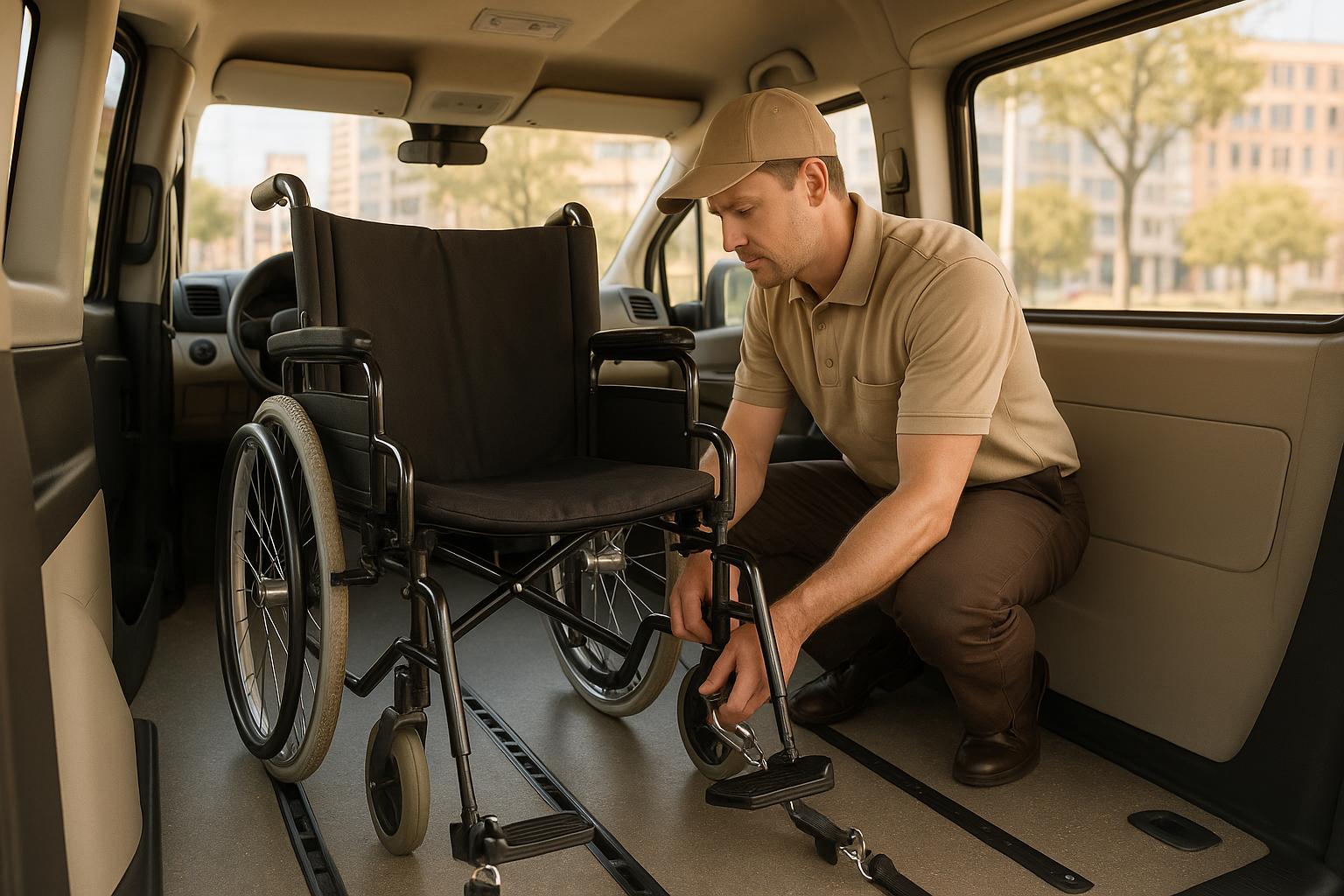
The four-point tie-down system relies on two front and two rear straps with hooks, which connect to specific points on the wheelchair frame and vehicle floor anchors. This setup locks the wheelchair in place to prevent movement during transit, adding an extra layer of safety in case of an accident. However, while this system secures the wheelchair, it doesn’t restrain the passenger. To ensure full safety, it must be paired with occupant restraint systems.
Manual, Retractable, and Automatic Systems
NEMT vehicles use various securement systems to balance affordability, efficiency, and user convenience. Manual systems, which cost around $99, require drivers to attach straps manually. Retractable systems, priced between $350 and $575, streamline the process by enabling quicker adjustments. At the higher end, automatic systems cost between $1,800 and $2,400 and secure wheelchairs with minimal driver effort. These advanced systems not only save time but also reduce physical strain on drivers, making operations smoother and more efficient.
Occupant Restraint Systems (WTORS)
Wheelchair Tiedown and Occupant Restraint Systems (WTORS) combine tie-down straps with lap and shoulder belts to secure both the wheelchair and its occupant. These systems include floor anchors, straps, and restraints to ensure safety during transit. For the best protection, wheelchair users should face forward and wear crash-tested lap and shoulder belts. This setup stabilizes both the wheelchair and the passenger, providing peace of mind during travel. The next section will break down the proper steps for applying these systems effectively.
The Ins and Outs of Wheelchair Securement In Your NEMT Work
sbb-itb-8e5d2ef
How to Secure a Wheelchair Safely
Step-by-Step Guide to Securing Wheelchairs Safely in NEMT Vehicles
Preparing the Vehicle and Equipment
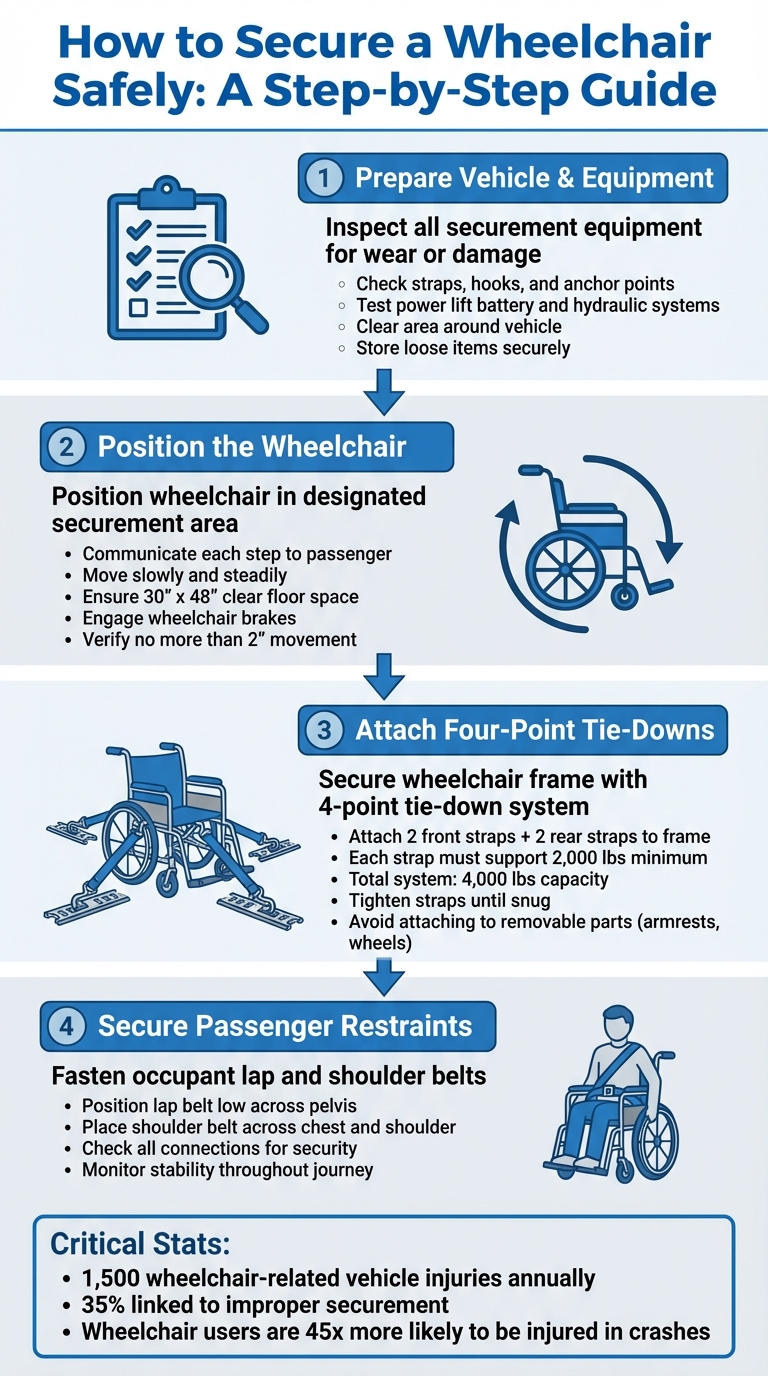
Before boarding a passenger, take a moment to inspect all securement equipment. Check straps, hooks, and anchor points for any signs of wear or damage. If the vehicle uses a power lift, test the battery levels and make sure the hydraulic systems are operating smoothly to avoid complications during boarding. Clear the area around the vehicle before deploying ramps or lifts – this minimizes the risk of accidents. Inside the vehicle, store any loose items securely to prevent them from shifting during the trip. Once everything is set, focus on positioning the wheelchair correctly.
Positioning the Wheelchair Correctly
Walk the passenger through each step of the process so they feel informed and comfortable. When guiding the wheelchair onboard, move it slowly and steadily to avoid startling or unbalancing the passenger. The securement area must provide at least 30 x 48 inches of clear floor space for the wheelchair. Once in position, engage the wheelchair’s brakes to keep it stationary. Double-check that it is firmly set – ideally, it should not shift more than two inches in any direction. After confirming the wheelchair is stable, proceed to secure it using the proper straps and restraints.
Using Straps and Restraints Properly
Secure the wheelchair by attaching two straps to the front and two to the back of its frame, anchoring each to the floor. Make sure each strap can handle at least 2,000 pounds, with the entire system supporting a minimum of 4,000 pounds. Tighten the straps so they are snug – loose tie-downs can compromise safety. Avoid attaching straps to removable parts like armrests or wheels, as these components might detach under pressure.
After securing the wheelchair, fasten the passenger’s lap and shoulder belts. Position the lap belt low across the pelvis to prevent sliding, and ensure the shoulder belt rests properly across the chest and shoulder. Before starting the trip, check all connections for security and keep an eye on the wheelchair’s stability throughout the journey.
Securing Different Types of Wheelchairs
The process of securing a wheelchair during transit varies slightly depending on the type of wheelchair being used. While the general principles remain consistent, adjustments are necessary to ensure safety and stability.
Manual, Power, and Specialty Chairs
Manual wheelchairs are compatible with both manual and retractable tie-down systems. These wheelchairs are lightweight and easier to maneuver, but they typically require assistance for proper securement. The process involves attaching four straps to the frame, following standard protocols.
Power wheelchairs, on the other hand, are significantly heavier and include electronic components that must be powered off before transit. Due to their design, they often require specialized securement methods. While automatic docking systems are available, they are rarely utilized in Non-Emergency Medical Transportation (NEMT) settings.
Specialty chairs, such as tilt-in-space models, demand extra attention. For these types, it’s essential to attach both the front and rear straps to the seat or base frame to ensure maximum stability during transit.
Non-WC19-Compliant Wheelchairs
Not all wheelchairs meet WC19 standards, which means they lack dedicated securement points. In these cases, securement should be achieved by attaching four-point tie-down straps to welded frame junctions or fixed steel bolt points. When identifying strong attachment points, look for bolts with six raised lines or bumps on the head, as these indicate durability. Avoid connecting straps to adjustable or removable parts like footrests or headrests, as these components can shift or fail under stress. For rear straps, position them at angles between 30° and 45° to the horizontal to enhance stability. It’s also important to avoid clamp-type devices, as they have shown poor performance in crash testing. These practices align with NEMT safety protocols, ensuring the protection of passengers during transport.
Managing Medical Accessories
Securing the wheelchair is just one part of the process. Managing attached medical accessories is equally important to ensure passenger safety. Many wheelchair users travel with items like oxygen tanks, leg supports, or other medical equipment. Loose objects should be firmly fastened to prevent injury during sudden stops. If an oxygen tank is mounted on the wheelchair, confirm that it is securely attached to the frame and will not shift during transit. Leg supports and other accessories must be positioned carefully to avoid interference with tie-down straps or occupant restraints. Drivers trained through Passenger Assistance, Safety, and Sensitivity (PASS) certification are equipped to handle these scenarios safely and effectively.
Conclusion
Ensuring proper wheelchair securement is about more than just meeting regulations – it’s about saving lives. Passengers using wheelchairs are 45 times more likely to be injured in a crash compared to other passengers. This statistic underscores the critical importance of securement systems that are correctly installed and used.
A combination of four-point tie-down systems and occupant restraints forms a sturdy safety framework designed to handle significant impact forces. When used properly, these systems keep wheelchairs stable during collisions. Beyond crash scenarios, proper securement also prevents discomfort, pressure injuries, and the stress caused by unstable positioning during travel. Service providers are at the forefront of ensuring these safety measures are consistently upheld.
Zyvra Mobility exemplifies this commitment by offering ADA-compliant vehicles equipped with industry-standard securement systems and staffed by highly trained drivers. Based in Austin, Zyvra Mobility ensures that every driver is well-versed not only in the technical aspects of wheelchair securement but also in treating passengers with respect and care. Their drivers undergo rigorous training, including PASS certification, to handle various wheelchair types, manage medical equipment, and prioritize passenger dignity.
However, technical safety is only part of the equation. Transportation challenges remain a significant barrier for many – each year, 3.6 million people miss or delay medical appointments due to transportation issues. Reliable and safe wheelchair transport eliminates this obstacle, enabling access to healthcare without compromising safety. Regular vehicle maintenance and strict adherence to safety protocols ensure that passengers receive consistent, dependable service. These measures work hand-in-hand with securement practices to provide a seamless and safe travel experience.
When Non-Emergency Medical Transportation (NEMT) providers combine the right equipment, comprehensive training, and a genuine commitment to passenger care, wheelchair transportation becomes more than a service – it becomes a safe and dignified journey, empowering individuals to attend medical appointments with confidence and ease.
FAQs
What’s the difference between ADA and WC19 standards for securing wheelchairs in vehicles?
The ADA (Americans with Disabilities Act) sets clear guidelines to ensure the safety of wheelchair users during vehicle transport. It requires wheelchairs to be secured with a four-point tie-down system, paired with a three-point occupant restraint system. To maximize safety, these standards limit wheelchair movement to no more than 2 inches during transit.
Meanwhile, the WC19 standard focuses specifically on wheelchairs intended for use as seating in motor vehicles. These wheelchairs undergo rigorous crash testing to simulate impacts at 30 mph with 20 g-forces. They must include clearly marked securement points designed to meet precise geometric specifications, ensuring proper attachment and enhanced protection for the occupant.
While both standards aim to safeguard passengers, WC19 goes further by addressing the unique requirements of wheelchairs used directly as vehicle seating.
How can I tell if my wheelchair meets WC19 safety standards?
To comply with WC19 safety standards, a wheelchair must successfully endure a 30 mph frontal impact crash test subjected to a force of 20 g. Additionally, it needs to feature four clearly marked securement points capable of withstanding crash forces and include labels indicating compliance with these standards. These elements are crucial to ensure the wheelchair is safe for use in transportation vehicles, such as non-emergency medical transport (NEMT).
What are the advantages of using automatic wheelchair securement systems in NEMT vehicles?
Automatic securement systems bring multiple advantages to both wheelchair users and Non-Emergency Medical Transportation (NEMT) services. These systems ensure that wheelchairs remain firmly in place during transit, significantly reducing the risk of shifting and enhancing overall passenger safety.
Another standout benefit is how they simplify the boarding process. By securing wheelchairs in just seconds, they eliminate lengthy delays and the need for manual adjustments, saving time and effort for everyone involved.
With their ability to boost efficiency and dependability, these systems provide a more seamless and stress-free experience for both passengers and drivers. As a result, they’ve become a critical component of today’s NEMT vehicles.