
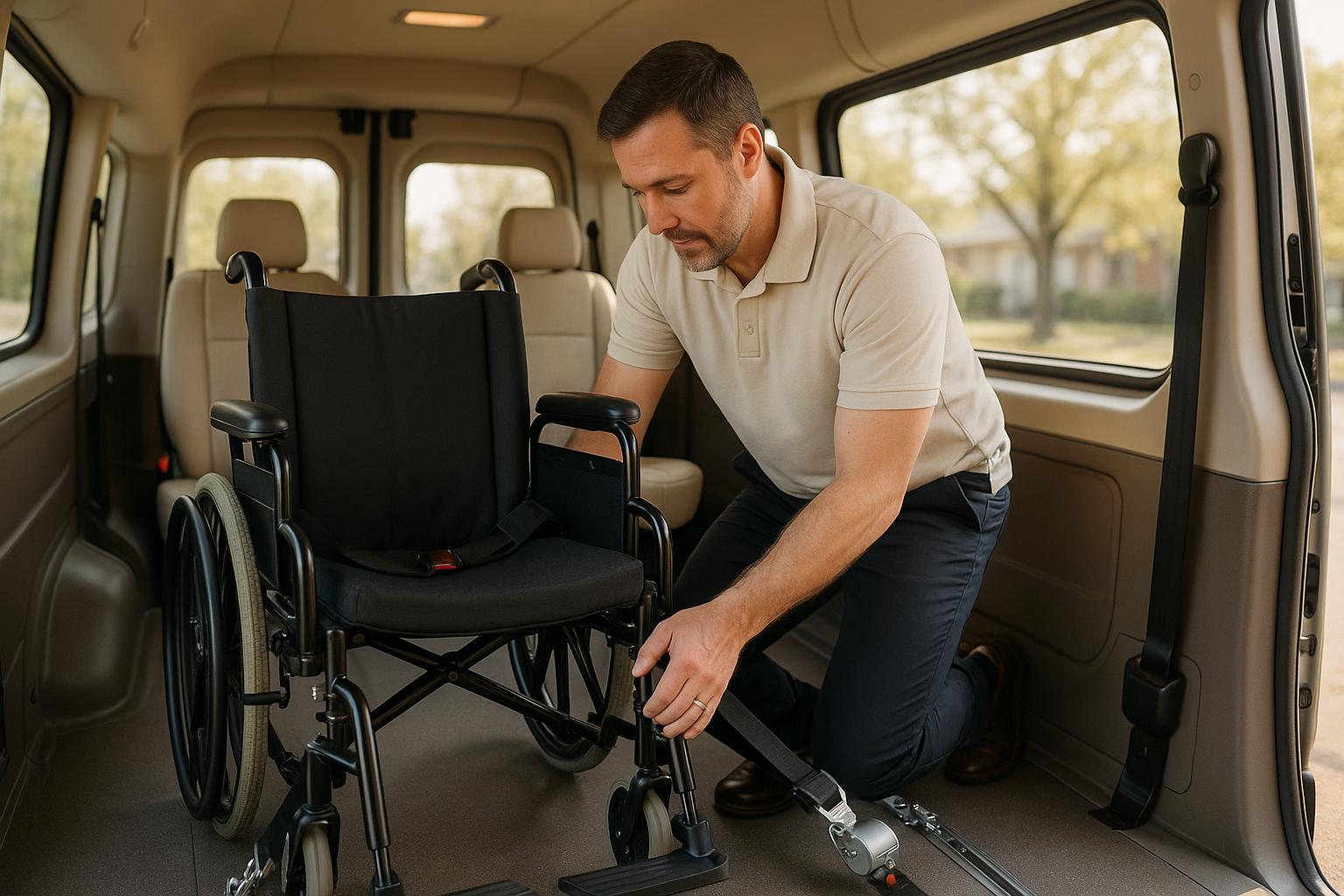
Wheelchair transport safety is critical for ensuring passengers with disabilities travel securely and comfortably. The key areas to focus on include:
- Vehicle and Equipment Preparation: Regular inspections and maintenance of vehicles, ramps, lifts, and securement systems are essential to prevent failures.
- Proper Wheelchair Securement: Use approved systems to secure both the wheelchair and the passenger independently.
- Safe Driving Practices: Smooth driving minimizes risks like tipping or sudden movements during transit.
- Staff Training: Hands-on training ensures drivers and attendants can operate equipment correctly and assist passengers with care.
The Ins and Outs of Wheelchair Securement In Your NEMT Work
Regulatory Standards and Requirements
Meeting regulatory standards is essential for reducing risks and ensuring the safety of passengers in non-emergency medical transportation (NEMT). Below, we break down the key mandates and safety guidelines that govern wheelchair transport.
ADA Requirements for NEMT
The Americans with Disabilities Act (ADA) establishes the core requirements for accessible transportation. Under the ADA, vehicles must be equipped to allow wheelchair users to board, ride, and exit safely. This includes features like ramps, lifts, and secure entryways. To stay compliant, vehicles must undergo regular inspections, and any necessary repairs should be addressed promptly.
ANSI/RESNA Standards
The American National Standards Institute (ANSI) and the Rehabilitation Engineering and Assistive Technology Society of North America (RESNA) set technical guidelines to ensure safe wheelchair transport. Two key standards – WC19 and WC18 – focus on crashworthiness for wheelchairs and seating systems. These standards specify that wheelchairs should be secured with a four-point strap tiedown system, while passengers are protected with occupant restraint systems. Using equipment certified under these standards is critical for maintaining a safe environment during transport.
Basic Safety Principles
Adhering to universal safety practices is just as important as meeting formal regulations. Here are some key principles for safe wheelchair transport:
- Separate Securement Systems: The wheelchair and the passenger should be restrained independently. An approved tiedown system should secure the wheelchair, while a separate restraint system should protect the passenger.
- Proper Belt Positioning: Lap and shoulder belts must be routed correctly to provide maximum safety without causing discomfort or harm.
- Certified Equipment and Maintenance: Use certified securement systems, conduct regular inspections, and follow a consistent maintenance schedule. Documenting inspections, maintenance activities, and any incidents or near-misses ensures accountability and supports ongoing safety improvements.
These guidelines form the backbone of safe practices for vehicle preparation, boarding, securement, and transportation.
Vehicle and Equipment Preparation
Ensuring vehicles and equipment are ready is the backbone of safe wheelchair transport. Before any passenger boards, it’s essential that the vehicle and all securement systems meet strict accessibility standards and function properly. The guidelines below outline the necessary vehicle modifications and equipment checks to prioritize safety.
Vehicle Accessibility and Modifications
A wheelchair-accessible vehicle requires more than just extra space. It must be equipped with Wheelchair Tie-Down and Occupant Restraint Systems (WTORS) to securely transport passengers in wheelchairs.
Ramps and lifts are vital for entry and exit. These systems should deploy smoothly and sit level with the ground to minimize risks like tipping or rolling. When parking for loading, choose a spacious, low-traffic area that allows the ramp or lift to fully extend. Avoid uneven surfaces or tight spaces that make maneuvering difficult.
The vehicle floor must have anchor points designed for a four-point tie-down system. Rear anchor points should align directly behind the wheelchair, while front points should be slightly wider than the wheelchair itself. Options for securement include traditional four-point restraint systems and power lockdown docking systems, both designed to firmly attach the wheelchair to the floor.
In addition to securing the wheelchair, vehicles must provide lap and shoulder belts specifically designed for passengers who remain seated in their wheelchairs. Safety doesn’t stop with securement systems – loose objects or equipment inside the vehicle should also be secured to prevent them from becoming hazardous during sudden stops.
Inspection and Maintenance
Routine maintenance of the vehicle and securement systems is critical to avoid potential failures that could jeopardize passenger safety. As experts emphasize:
Regular maintenance checks for all equipment are essential to ensure safety and reliability, involving inspections for wear and tear, battery levels, and hydraulic functionality.
Pre-trip checks should be a standard practice. Before each journey, confirm that the WTORS is WC18 certified and compatible with the specific wheelchair being used.
Inspections should cover key areas, including ramps, lifts, tie-down straps, and fasteners. Look for signs of mechanical damage, rust, fraying, or general wear. Check battery levels and hydraulic systems to ensure they’re functioning correctly.
Proper installation is just as important as the quality of the equipment. Any safety equipment, especially after-market additions, must be installed to meet strict safety standards.
Loading and unloading procedures should always be done carefully to prevent equipment damage, wheelchair issues, or passenger injuries. Taking the time to perform these steps correctly not only ensures safety but also prolongs the life of the equipment.
Regular maintenance goes beyond meeting basic requirements – it’s about providing passengers with safe and dependable transport every time.
Boarding, Positioning, and Securement
After inspecting the equipment, the next step is ensuring the passenger boards safely and their wheelchair is properly secured. Sticking to established procedures reduces risks and promotes both safety and comfort during transport.
Safe Boarding Procedures
Choose a boarding area that allows the ramp or lift to fully extend without any obstructions. Look out for potential hazards like curbs or debris that might interfere.
When deploying the ramp or lift, make sure it’s level with the ground. Help the passenger onto the platform carefully, ensuring they maintain their balance.
For lifts, it’s ideal to have two staff members available. If only one is present, secure the wheelchair by engaging the brakes or using safety straps, and make sure non-wheelchair users are seated rather than standing on the platform. Never leave a passenger unattended on the ramp or lift.
Proper Wheelchair Securement
After the passenger has boarded, secure their wheelchair using an approved tie-down system. Follow your organization’s specific guidelines to ensure the wheelchair remains stable throughout the trip. Take a moment to double-check all connection points for added security.
Passenger Positioning
Once the wheelchair is secure, focus on the passenger’s positioning. Make sure they are seated comfortably, with the wheelchair placed to avoid contact with surrounding objects. Check that any additional supports are properly secured and confirm with the passenger that they feel stable and comfortable before starting the journey.
At Zyvra Mobility, these practices are part of our everyday operations, ensuring safe and reliable transportation for all passengers. By consistently applying these steps, we uphold the highest standards of care on every ride.
sbb-itb-8e5d2ef
In-Transit Safety and Unloading
Once the passenger is securely positioned and the journey begins, maintaining safety involves careful driving, consistent monitoring of equipment, and following proper unloading procedures.
Safe Driving Practices
Smooth and cautious driving is key to minimizing sudden movements that could harm passengers or compromise the stability of wheelchairs. Abrupt stops or sharp turns can cause serious issues, such as passengers being thrown from their chairs, sliding under lap belts, or wheelchairs tipping over.
To avoid these risks:
- Accelerate gently and brake gradually to reduce sudden jolts.
- Take turns slowly and anticipate road conditions to avoid abrupt maneuvers.
- Slow down on uneven surfaces like potholes, speed bumps, or railroad crossings. When unavoidable, approach obstacles at a reduced speed and a perpendicular angle to minimize impact.
Continuously check mirrors to monitor for shifting equipment or passenger discomfort. If a wheelchair moves more than two inches in any direction, pull over safely to re-secure it. Always ensure the wheelchair’s parking brakes are engaged, and for powered wheelchairs, keep them turned off during transit to prevent accidental movements.
Remove hard lap trays before starting the trip and secure them separately to avoid potential injuries.
By following these driving practices, you set the stage for a safe and efficient unloading process upon arrival.
Unloading Procedures
When unloading, choose a firm, level surface and engage the vehicle’s parking brakes. Fully extend stabilizers to ensure stability. Park away from crowded areas or traffic to allow the lift to operate without obstructions.
Before starting, inspect the wheelchair’s brakes to confirm they are functional. Make sure the wheelchair is securely strapped, and check all securing devices for damage. Verify that unloading equipment, like ramps or lifts, is in proper working condition.
Engage the wheelchair brakes before operating the lift or ramp to prevent rolling. For powered wheelchairs, turn off the power to avoid unintended movement. Ensure the lift gate aligns evenly with the ground before moving the wheelchair. If the wheelchair was loaded rear-facing, unloading may require less maneuvering, as it can often be pushed straight out.
During lift operation, remind the passenger to keep their arms and legs inside the platform area to avoid injuries from moving parts. Use the lift platform safety strap if available.
Take your time during the unloading process. Rushing can lead to mistakes, so proceed methodically and communicate with the passenger to keep them informed and comfortable every step of the way.
Staff Training and Quality Assurance
While having reliable equipment and strict protocols is vital, the safety of wheelchair transport heavily relies on the skills and consistency of well-trained staff. Drivers and attendants must know how to handle both the equipment and the passengers with care and precision.
Competency-Based Training
Training isn’t just about reading a manual – it requires hands-on practice. Staff should work directly with securement systems and lift equipment to ensure they’re comfortable and confident in using them. This training should cover three key areas: proper equipment operation, adherence to safety protocols, and passenger care with sensitivity.
Certification programs like Passenger Assistance, Safety, and Sensitivity (PASS) and Certified Transport Specialist (CTS) help establish a clear standard of competence. These programs prepare staff to assist passengers, secure wheelchairs properly, and respond to emergencies effectively.
To keep skills sharp, regular refresher courses are essential. These sessions should update staff on the latest best practices and safety protocols. Incorporating real-world case studies into training can make lessons more relatable and impactful.
But training alone isn’t enough. To ensure consistency, organizations need formal written policies that clearly outline expectations and procedures.
Standard Operating Procedures
Written policies act as a guidebook for staff, ensuring that everyone follows the same steps. Detailed standard operating procedures (SOPs) should cover everything from pre-trip vehicle inspections to emergency response protocols. Practical tools like checklists and forms can help staff stay on track and allow supervisors to evaluate performance effectively.
These SOPs don’t just maintain consistency – they also lay the groundwork for continuous improvement.
Continuous Improvement
Improving staff performance is an ongoing process. Regular evaluations are critical for identifying areas where safety can be strengthened, helping to reduce accidents and injuries. Maintaining detailed records of staff performance and incidents enables organizations to spot trends and take proactive steps to improve wheelchair transport safety.
Conclusion
Ensuring wheelchair transport safety involves a mix of essential practices – from adhering to regulations and conducting thorough equipment checks to using effective securement systems. Safe boarding and unloading procedures play a key role in minimizing risks at every stage of the journey.
But safety isn’t just about equipment – it’s also about the people. Well-trained staff are the bridge between policy and practice. Without proper training, drivers may struggle with tasks like operating hydraulic lifts or securing wheelchairs correctly. Hands-on experience with securement systems, emergency response skills such as CPR and first aid, and a compassionate approach to assisting passengers with disabilities are all critical to providing a safe and supportive experience.
When organizations embrace these practices, they go beyond simply meeting requirements – they earn the trust of the passengers who rely on their services.
Take Zyvra Mobility in Austin, Texas, as an example. Their dedication to safety highlights that reliable transportation isn’t just about ticking boxes. It’s about embedding safety and respect into every part of the service. With preparation, proper techniques, and skilled staff working together, transportation becomes what it should be: a secure and dignified experience that helps people reach their destinations with confidence.
FAQs
What is the difference between WC19 and WC18 standards for wheelchair securement, and why do they matter?
The WC19 standard is all about wheelchairs built specifically for transportation. It includes requirements like crash-tested frames, reinforced brackets, smooth edges, and compatibility with occupant restraint systems. Meanwhile, the WC18 standard focuses on Wheelchair Tiedown and Occupant Restraint Systems (WTORS), ensuring these systems are crash-tested and meet strict safety guidelines.
These standards play a key role in improving passenger safety during transport. By ensuring that both the wheelchair and its securement systems work effectively in a collision, they help reduce the risk of injury.
How can organizations ensure their staff are properly trained and stay current with wheelchair transport safety practices?
To ensure staff are ready for the demands of their roles, organizations should provide thorough training programs that emphasize hands-on practice. This includes mastering wheelchair securement systems and learning proper patient handling techniques. Regular refresher courses are key, particularly when new vehicles, equipment, or updated safety protocols come into play.
Keeping up with changes in industry guidelines is another critical step. Integrating these updates into training sessions helps maintain top-notch safety standards. Encouraging open communication within the team can also highlight improvement areas and bolster a workplace culture centered on safety and professionalism.
What are the most common mistakes when securing a wheelchair and passenger in a vehicle, and how can they be avoided?
When securing a wheelchair and passenger, there are a few common missteps to watch out for. These include not positioning the wheelchair to face forward, attaching straps to parts that can detach, and leaving straps too loose. Such mistakes can put safety at risk during transport.
To prevent these problems, always stick to ADA guidelines and, if available, use a WC19-certified wheelchair for added reliability. Take the time to double-check every strap and connection, ensuring they’re tight and properly secured before hitting the road. These steps help guarantee a safe and smooth ride for everyone involved.