
Certified Non-Emergency Medical Transportation (NEMT) staff are essential for ensuring safe and reliable transportation for individuals who cannot drive due to mobility challenges, age, or health conditions. The NEMT industry is expanding rapidly, with the market projected to grow from $8.65 billion in 2021 to $15.57 billion by 2028, emphasizing the need for properly trained personnel.
Key Points:
- Certified staff follow wheelchair transport safety best practices when handling specialized equipment like stretchers, follow ADA guidelines, and are trained in first aid, CPR, and emergency protocols.
- Widely recognized certifications include Passenger Assistance Safety and Sensitivity (PASS), Certified Transport Specialist (CTS), and safety training programs.
- Certification ensures compliance with regulations, improves safety, and is often required for securing contracts and reimbursements from brokers like Medicare and Medicaid.
- Providers like Zyvra Mobility set high standards by requiring certifications and ongoing training, ensuring both patient safety and service quality.
Investing in certified NEMT staff not only improves patient care but also helps providers meet industry standards and maintain compliance in a growing market.
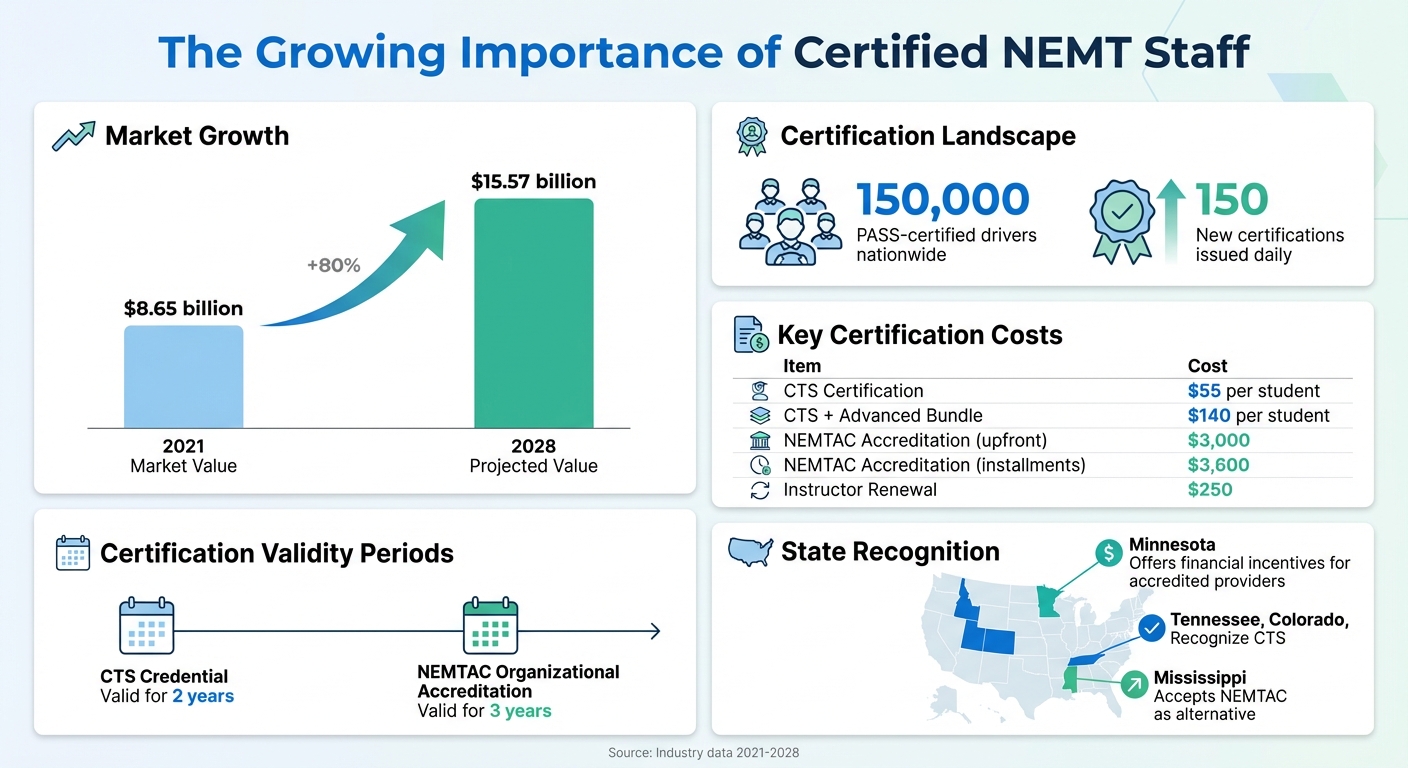
NEMT Industry Growth and Certification Statistics 2021-2028
NEMT Driver Training and Certification
Required Qualifications and Certifications for NEMT Staff
To ensure high-quality service and compliance in Non-Emergency Medical Transportation (NEMT), specific qualifications and certifications are becoming industry benchmarks. While no federal regulations mandate these credentials, organizations like the Community Transportation Association of America (CTAA) and the National Emergency Medical Transportation Accreditation Commission (NEMTAC) have set widely recognized standards. Many leading NEMT brokers now require these certifications, making them essential for providers looking to secure contracts and maintain reimbursement eligibility.
Key certifications include Passenger Assistance Safety and Sensitivity (PASS), Certified Transport Specialist (CTS), and core safety training in CPR, First Aid, and Defensive Driving. These programs cover critical areas like wheelchair securement, emergency response, and professional ethics. With over 150,000 PASS-certified drivers nationwide and 150 new certifications issued daily, the push toward standardized training is evident. These qualifications equip NEMT staff to deliver safe, reliable, and compassionate care.
Passenger Assistance Safety and Sensitivity (PASS) Certification
The PASS certification is a cornerstone for NEMT staff, particularly for those assisting passengers requiring extra care, such as seniors and individuals with disabilities. Developed by CTAA, this program is widely recognized as the gold standard for passenger assistance. It includes 19 self-paced online modules focused on safe and sensitive passenger handling.
“CTAA’s Passenger Assistance, Safety and Sensitivity (PASS) driver training program is the benchmark for safe, sensitive passenger transport.” – Community Transportation Association of America (CTAA)
However, the online-only version lacks hands-on training for wheelchair securement. To address this, combining the online modules with in-person, practical training is recommended. This hybrid approach ensures drivers are fully prepared to handle real-world situations involving mobility devices like wheelchairs and walkers.
Certified Transport Specialist (CTS) Credential
The Certified Transport Specialist (CTS) program, developed by NEMTAC, is the first nationally accredited certification tailored specifically for NEMT drivers. At a cost of $55 per student, it covers essential topics like customer service, ethics, HIPAA compliance, and safety protocols.
“The Certified Transport Specialist (CTS®) program is the first nationally accredited training program for Non-Emergency Medical Transportation (NEMT) drivers, fully aligned with the Transportation Specialist Education Standard.” – NEMTAC
The CTS credential is valid for two years and must be renewed to maintain compliance with national standards. It also serves as a prerequisite for advanced certifications, such as Advanced Mobility Device Securement (AMDS) and Certified Stretcher Operator (CSO), which can be bundled for $140 per student. States like Tennessee, Colorado, and Idaho officially recognize CTS, and Mississippi allows NEMTAC accreditation as an alternative to traditional state licensing.
CPR, First Aid, and Defensive Driving Training
In addition to specialized NEMT certifications, CPR, First Aid, and Defensive Driving form the essential safety foundation for all staff. These skills prepare drivers to manage medical emergencies during transit, such as cardiac events or choking incidents.
Defensive driving is especially important in NEMT, as it emphasizes smooth vehicle operation to avoid sudden movements that could harm frail or medically vulnerable passengers. Ensuring comfort and safety during transit is a top priority for passengers who may already be dealing with pain, fatigue, or anxiety.
“Defensive Driving Techniques: Drivers learn to operate vehicles smoothly and navigate safely.” – Safr Care
For instance, HealthLift NEMT of Arizona mandates that all drivers in Phoenix and Tucson hold certifications in PASS, CPR, Defensive Driving, and Hospice Sensitivity by 2025. They also require pre-employment and random drug testing, along with background checks, to uphold high standards for bariatric and stretcher transport. This comprehensive approach highlights how leading providers integrate multiple certifications to ensure both compliance and exceptional care.
Patient Safety and Regulatory Compliance
Ensuring compliance with regulations is essential for protecting patients and maintaining operational standards. Certified NEMT (Non-Emergency Medical Transportation) staff play a crucial role in safeguarding patients, especially those who rely on specialized equipment during transport. Federal guidelines, specifically 49 CFR 37.173, mandate that all personnel receive proficiency training to operate vehicles and equipment safely while treating individuals with disabilities respectfully and courteously. This not only helps prevent injuries but also preserves the dignity of those being transported and ensures safe medical transport.
The financial implications of compliance are just as important. Providers must adhere to these standards to qualify for Medicare and Medicaid reimbursements, which require a National Provider Identifier (NPI). NEMTAC accreditation is considered the gold standard for operational excellence, costing $3,000 upfront or $3,600 through installments, plus a $600 non-refundable fee. Some states, such as Mississippi, accept NEMTAC accreditation as a substitute for traditional state licensing, while Minnesota offers financial incentives for accredited providers. With the NEMT industry forecasted to grow from $8.65 billion in 2021 to $15.57 billion by 2028, maintaining these certification standards is vital for both patient safety and the sustainability of businesses.
ADA Compliance and Accessibility Practices
Certified NEMT staff are required to follow ADA (Americans with Disabilities Act) guidelines, which emphasize accessibility and equal treatment. This includes providing door-to-door assistance when needed, ensuring proper use of equipment, and following equal-access practices. For example, ADA rules state that staff must offer assistance beyond the curb if a passenger requires it – unless doing so poses a direct safety risk or fundamentally alters the service.
The responsibilities extend to specific tasks such as safely using ramps or lifts, securing mobility devices like wheelchairs or scooters, and correctly handling child or booster seats. Additionally, staff must ensure that passengers with disabilities are not denied service, are not required to travel with an attendant, and are not charged extra for accommodations mandated by ADA. For passengers traveling with service animals (dogs or miniature horses, as defined by the ADA), staff may only ask two questions: whether the animal is required due to a disability and what task it has been trained to perform.
Different service protocols apply based on the passenger’s needs (Some patients may also benefit from specialized seating solutions such as the Broda Traversa Transport Chair, which offers additional positioning support and comfort during transport.):
- Mode 4 (Assisted): Requires help boarding and exiting the vehicle.
This level of support is common in Ambulatory NEMT, where patients can remain seated normally but still need help getting to and from appointments.
- Mode 5 (Lift-equipped): Involves securing mobility devices.
- Mode 7 (Stretcher): Includes safe loading, unloading, and continuous monitoring.
Routine pre-trip inspections of vehicle lifts and securement systems are also essential to ensure vehicles remain “readily accessible” under ADA standards. These practices build trust and reinforce the value of certified training.
Emergency Response Protocols
Although NEMT services are designed for patients who do not require in-transit medical care, staff must be prepared for unexpected situations. If a patient’s condition changes and medical intervention becomes necessary, the service is upgraded to emergency ambulance transportation. In cases of sudden health changes or urgent care needs, staff follow protocols for a “one-time assessment” to determine if an immediate adjustment in service level is required. Urgent care is defined as a condition that could escalate into an emergency if not addressed within 24 hours.
“NEMT providers must consider the safety of the member first when deciding whether to transport or to provide or use a specific level of service during times of inclement weather.” – Minnesota Department of Human Services
During severe weather or urgent situations, staff may adjust service levels or delay transport to prioritize essential treatments like dialysis, chemotherapy, or radiation. For high-risk transports, such as those requiring stretchers (Mode 7), additional attendants may be required to ensure safety. Providers also rely on systems like MN-ITS to verify a passenger’s certified level of service and any specific safety needs before pickup, ensuring the appropriate equipment and personnel are assigned. For higher-acuity trips, Stretcher NEMT requires the right equipment, vehicle setup, and trained staff to keep patients safe throughout transport. All details are meticulously documented to confirm adherence to protocols.
sbb-itb-8e5d2ef
Zyvra Mobility‘s Commitment to Certified NEMT Personnel
Zyvra Mobility, founded by Wesley Burris in Austin, TX, sets a high standard for Non-Emergency Medical Transportation (NEMT) personnel through rigorous training and strict compliance measures. Learn more about our mission, standards, and story on our About Us page. Every driver undergoes mandatory Texas-specific training within their first 30 days of employment. This training covers a comprehensive range of topics, including defensive driving, passenger assistance techniques, proper use of assistive devices, customer service, diversity awareness, and fraud prevention. To ensure ongoing compliance with state regulations, this training is refreshed every 1 to 3 years.
The company also emphasizes national certifications to uphold professionalism and safety. Drivers hold key certifications, such as CTS and advanced credentials, which further highlight Zyvra Mobility’s dedication to safe and reliable transportation. Additionally, all staff maintain up-to-date CPR and First Aid certifications, meeting the expectations of major Texas medical brokers. This commitment to certification extends beyond personnel to the company’s state-of-the-art vehicle fleet.
“Certified NEMT drivers have undergone training and testing that helps to ensure they are competent and capable of providing safe non-medical transportation for their passengers.” – MediRoutes
Zyvra’s ADA-compliant fleet is equipped with advanced safety features such as hydraulic lifts, four-point tie-down systems, and gearshift interlocks. Each vehicle adheres to Texas Medicaid standards and is outfitted with first aid kits and fire extinguishers. The company also leverages cutting-edge technology, including AI-powered dispatch and Driver Insights, to optimize routes, improve safety, reduce fuel consumption, and lower insurance costs. Together, this combination of certified personnel and advanced tools ensures a transportation service that prioritizes safety and reliability.
Continuing Education and Recertification Requirements
Continuing education is a key component in keeping NEMT staff updated with the latest protocols and standards. NEMT certifications come with expiration dates, ensuring that professionals stay in sync with evolving safety measures and regulations. For instance, the Certified Transport Specialist (CTS) credential must be renewed every two years, while organizational NEMTAC accreditation remains valid for three years.
“The recertification process encourages providers to remain current in EMS knowledge and maintain proficiency to renew their certification.” – National Registry of Emergency Medical Technicians
This process ensures that NEMT professionals retain their skills and adapt to changing protocols. It also reassures major brokers like Modivcare and MTM of their reliability and readiness. Brokers often require up-to-date certifications to continue partnerships, making timely renewals a critical factor in maintaining contracts and revenue. Fortunately, the recertification costs are structured to be clear and manageable.
As of April 2, 2025, the CTS course costs $55 per student. For those pursuing bundled certifications – such as CTS combined with Advanced Mobility Device Securement or Certified Stretcher Operator – the price is $140. Renewing instructor certifications costs $250, while organizational accreditation fees are $3,000 upfront or $3,600 when paid in monthly installments of $83.33.
Beyond standard recertification, continuous education plays a vital role in reinforcing service quality. Many organizations mandate post-incident online training after accidents or safety issues, even if certifications are still valid. This targeted training helps address specific weaknesses and reduces the likelihood of repeat incidents. To streamline the credentialing process, organizations are encouraged to use digital systems like ProCredEx. Failing to keep credentials updated can result in early termination of accreditation status.
Conclusion
Certified NEMT staff form the backbone of safe and respectful medical transportation. Through extensive training in areas like defensive driving, emergency response, and equipment handling, they help prevent accidents, improve patient outcomes, and maintain regulatory compliance. As Safr Care aptly puts it:
“Well-trained, certified drivers are at the heart of high-quality NEMT services, guaranteeing safe and supportive transport for patients facing mobility issues, chronic conditions, or heightened vulnerabilities”.
But technical expertise is only part of the equation. Certification programs also emphasize empathy, effective communication, and cultural awareness – qualities that elevate a ride into a meaningful healthcare experience. When drivers go the extra mile with door-through-door service, they not only ease patient anxiety but also build trust in the reliability of their care. This combination of skill and compassion creates a standard of service that truly stands out.
For healthcare providers and patients in Austin, partnering with a certified provider like Zyvra Mobility means access to professionals who are both accountable and consistently trained. Healthcare organizations can also explore our Care Partners program to streamline transportation coordination and improve the patient experience. This local commitment reflects how national certification standards can bring dependable, patient-focused care to the community. Ongoing certification ensures that these high standards are maintained.
As the NEMT market continues to expand, the demand for certified and dependable transportation grows with it. Certified staff do far more than just provide transportation – they safeguard lives, uphold dignity, and strengthen the healthcare system. Choosing an NEMT provider dedicated to these principles means prioritizing safety, quality, and care at every turn.
FAQs
What certifications do NEMT staff need to ensure safety and compliance?
To ensure non-emergency medical transportation (NEMT) services are both safe and compliant, staff members need to hold specific certifications. These generally include a valid driver’s license (with any required endorsements), CPR and First Aid certification, and HIPAA training to protect patient confidentiality. A clean criminal background check is also a fundamental requirement.
Many NEMT professionals also choose to earn additional credentials like the Certified Transport Specialist (CTS) certification. This certification helps them gain expertise in using specialized equipment such as wheelchairs and stretchers while meeting ADA-compliance standards. These qualifications play a crucial role in maintaining patient safety, ensuring comfort, and meeting healthcare regulations.
Why is certification important for NEMT providers when working with programs like Medicare and Medicaid?
Certification plays an important role for NEMT providers as it proves they adhere to federal and state safety standards. This compliance is vital for eligibility in Medicare and Medicaid programs. Without the proper certification, providers could face exclusion from these essential programs.
Moreover, brokers often favor or require certified providers when awarding contracts. Certification serves as a mark of trust, signaling that a provider is equipped to offer safe, dependable, and regulation-compliant transportation services. This not only helps secure valuable partnerships but also strengthens a provider’s position in a competitive market.
Why is it important for NEMT staff to undergo regular training and recertification?
Regular training and recertification play a key role in keeping NEMT staff prepared and informed about the latest safety procedures, correct handling of specialized equipment, and emergency response strategies. This ongoing education ensures they can deliver transportation that is not only safe and dependable but also comfortable for all patients, including those with specific medical requirements.
Staying certified also helps staff meet healthcare regulations and confidently manage tasks like operating ADA-compliant vehicles or handling stretchers and wheelchairs. This approach strengthens patient confidence, prioritizes safety, and minimizes risks for both healthcare providers and transportation services.