
AI is transforming Non-Emergency Medical Transportation (NEMT) by improving patient safety, reducing risks, and streamlining operations. Here’s how:
- Efficient Scheduling and Routing: AI systems reduce delays with real-time route optimization, cutting fuel costs by 30% and boosting on-time performance by 12%.
- Tailored Vehicle and Driver Pairing: Patients are matched with vehicles and drivers that meet their specific needs, ensuring safe and comfortable transport.
- Real-Time Monitoring: GPS and telematics track driving behaviors and trip progress, reducing late pickups by 40% and improving reliability.
- Safer Transfers: AI schedules buffer times for patient transfers, preventing injuries during transitions from wheelchairs or stretchers.
- Predictive Maintenance: Sensors predict equipment failures, minimizing breakdowns and cutting operational costs by up to 20%.
- Data Security: AI tools comply with HIPAA regulations, using encryption and role-based access to protect patient data.
Providers like Zyvra Mobility are leveraging these tools to reduce no-shows by 25%, improve Medicaid claim approvals, and enhance service reliability. Future advancements include predictive risk scoring, autonomous vehicles, and wearable health monitors.
AI is reshaping NEMT by ensuring safer, more reliable, and efficient patient transportation.
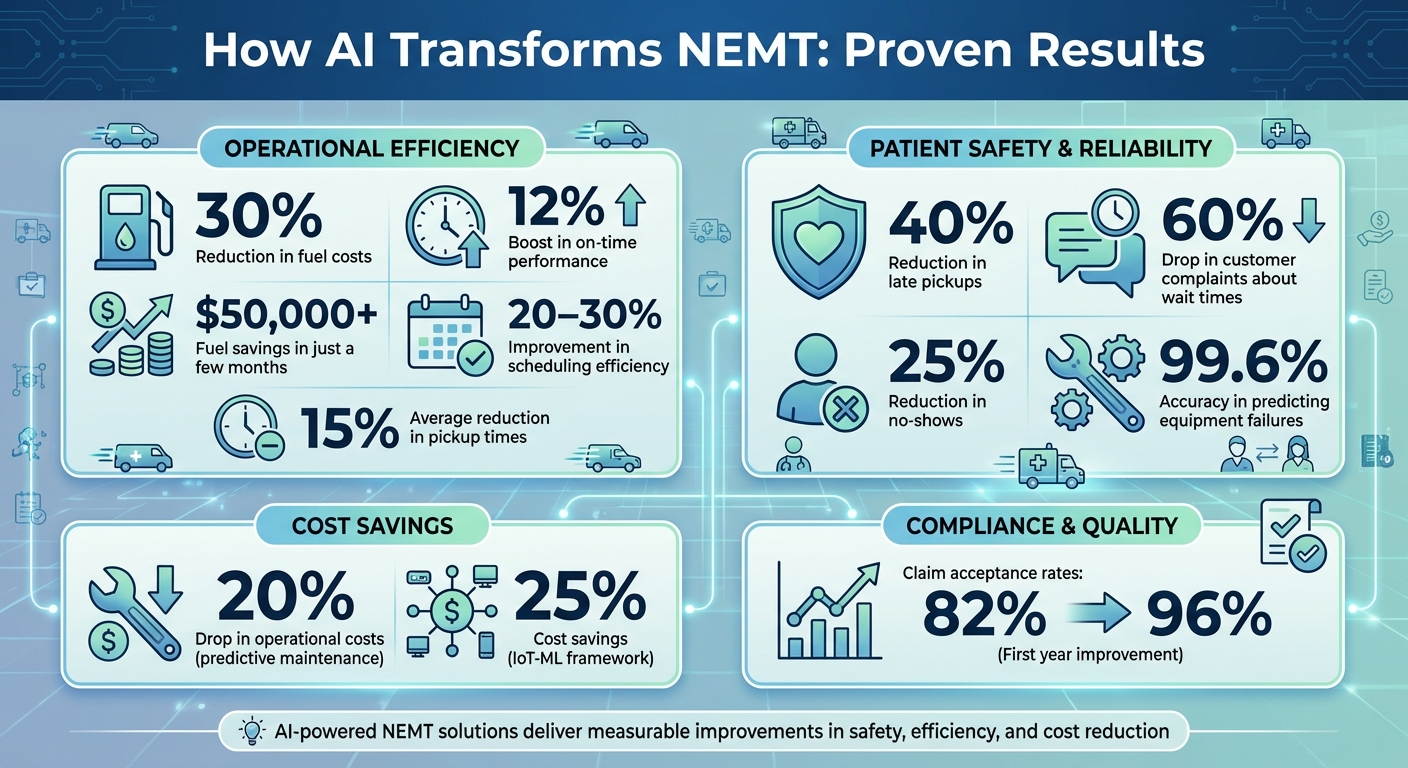
AI Impact on NEMT: Key Performance Metrics and Cost Savings
AI-Driven Dispatch and Routing for Better Safety and Punctuality
Real-Time Route Optimization for On-Time Transport
AI-powered systems are transforming transportation by recalculating routes in real time based on traffic, road closures, and weather conditions. If a delay pops up – like a traffic jam or a last-minute schedule change – the system adjusts instantly to keep patients on track. One provider saw impressive results: a 12% boost in on-time performance, a 30% cut in fuel consumption, and over $50,000 in fuel savings within just a few months.
These systems process thousands of requests within seconds, juggling factors like appointment times, driver availability, and locations. The result? Fewer missed appointments and improved health outcomes for patients who rely on timely transport. Plus, this level of optimization paves the way for precise vehicle and driver assignments.
Matching Vehicles and Drivers to Patient Needs
AI doesn’t stop at route planning – it also ensures patients are matched with the right vehicles. Whether someone needs a wheelchair lift, a stretcher tie-down, or bariatric accommodations, the system assigns vehicles equipped to meet those exact needs. This eliminates the risk of pairing a patient with a vehicle that lacks the necessary equipment.
Driver qualifications are also factored in. Patients requiring specialized care are matched with drivers who have the appropriate training, ensuring safety and compliance. This automated process not only adheres to ADA requirements but also balances workloads across the driver pool, making operations smoother for everyone.
Monitoring and Reducing Risk During Transit
Patient safety during transit is another area where AI shines. Using GPS and telematics, dispatchers can monitor trips in real time, keeping an eye on driving behaviors like speeding, harsh braking, or route deviations. If any issues arise, the system sends immediate alerts to both staff and patients. For example, a Medicaid-focused NEMT provider in New York reported a 60% drop in customer complaints about wait times after implementing real-time tracking.
Geofencing adds another layer of control, ensuring pickups and drop-offs happen within approved zones and timeframes. If a driver is running late or a trip veers off course, the system notifies dispatchers right away, allowing them to step in before it disrupts patient care. In California, one provider saw a 40% reduction in late pickups after adopting an integrated route optimization system, with drivers reporting less stress thanks to more efficient planning.
Non-Emergency Medical Transportation (NEMT) Dispatch Planning Demo | NextBillion.ai

AI Tools for Patient Handling and Transfer Safety
Together, these AI tools strengthen every aspect of patient transport safety.
Preventing Falls and Injuries During Transfers
Patient transfers – like moving someone from a wheelchair into a vehicle or securing a stretcher – are moments when accidents can happen. AI steps in to make these transitions safer by ensuring enough time is scheduled for each transfer. AI scheduling systems factor in mobility needs, vehicle type, and driver availability, creating buffer times to allow for safe and unhurried transfers.
AI also uses historical mobility data to identify patients at higher risk for injury. For instance, Mindbowser’s AI-powered driver-matching algorithms evaluate details like vehicle type, driver qualifications, and patient needs. A wheelchair user requiring a lift-equipped vehicle is matched with the nearest driver who meets those requirements. Similarly, bariatric or stretcher patients are paired with staff trained to handle their specific needs.
Vehicle tagging adds another layer of safety. Tools like NextBillion.ai’s Route Optimization API allow vehicles to be tagged with accessibility features, such as wheelchair lifts or stretcher tie-downs. This ensures that the right equipment is available for each patient. Routes can also account for extra handling time for patients with limited mobility, reducing the likelihood of rushed transfers that could lead to injuries.
This focus on safe patient handling complements AI’s role in keeping transport equipment in top shape.
Predictive Maintenance to Prevent Equipment Failures
AI doesn’t just make transfers safer – it also ensures that the equipment used during transport works reliably. Failures, like a malfunctioning wheelchair lift or a broken stretcher lock, can create serious safety risks. Predictive maintenance leverages sensor data and historical records to forecast potential equipment failures with up to 99.6% accuracy. This approach not only minimizes breakdowns but also cuts operational costs.
"AI algorithms have the ability to detect possible failure trends by evaluating massive volumes of data collected from equipment sensors and maintenance records. This proactive method enables prompt interventions, lowering the chances of equipment failure and enhancing patient safety." – Sara Awni Alkhatib et al.
One organization noted a 20% drop in operational costs thanks to the efficiency gains from predictive maintenance. Additionally, an IoT-ML framework achieved 25% cost savings. By replacing parts only when necessary instead of following fixed schedules, NEMT providers reduce unexpected breakdowns and ensure that critical safety equipment – like wheelchair lifts and stretcher locks – remains dependable and ready for use.
sbb-itb-8e5d2ef
Data Security and Ethical Use of AI in NEMT
AI can improve the efficiency and safety of Non-Emergency Medical Transportation (NEMT), but it also comes with serious responsibilities, especially when it comes to protecting patient data and ensuring fairness. AI systems in NEMT often handle Protected Health Information (PHI) like patient identifiers, trip details, and GPS data. This makes compliance with HIPAA regulations a top priority, as violations can lead to hefty fines. On January 6, 2025, the HHS Office for Civil Rights proposed the first major update to the HIPAA Security Rule in two decades. These changes eliminate the distinction between required and addressable safeguards while introducing stricter requirements for encryption and resilience in AI systems that process PHI. As regulations evolve, NEMT providers must prioritize strong data security and ethical AI practices.
Protecting Patient Data in AI Systems
Securing patient data is crucial at every stage of the NEMT process. Using technologies like TLS for securing data in transit and AES-256 for data at rest helps protect sensitive information. This level of security is just as important as optimizing routes to improve service. Furthermore, CMS and Medicaid audits increasingly examine NEMT vendors, focusing on the secure storage of trip logs, encrypted data transfers, and proper audit trails within dispatch and billing systems.
Another essential layer of protection is role-based access control (RBAC), which limits access to PHI based on job roles. For instance, drivers would only see the pickup and drop-off addresses they need, while dispatchers might have access to more detailed medical information. This approach minimizes unnecessary exposure to sensitive data. However, not all AI tools are HIPAA-compliant by default. Generative AI platforms like ChatGPT, for example, typically do not sign Business Associate Agreements (BAAs) with covered entities. NEMT providers should explore alternatives like BastionGPT or CompliantGPT, which offer HIPAA-compliant solutions and include BAAs.
Ethical AI Deployment for Fair Service
AI systems can unintentionally introduce bias, especially if their training datasets fail to represent diverse patient populations or if there are flaws in their design. This bias can affect how services are allocated, potentially leading to unequal treatment. To counteract this, inclusive data collection and regular audits are essential for ensuring fairness in service delivery.
Just as AI can optimize vehicle assignments, it should also be regularly reviewed to ensure equitable service for all patients, regardless of their background or location. The NIST AI Risk Management Framework (AI RMF) offers a structured way to assess and mitigate risks in AI systems. It emphasizes principles like validity, reliability, safety, security, explainability, privacy, and fairness – guidelines that align well with HIPAA’s privacy and security standards. These practices not only strengthen the ethical implementation of AI in NEMT but also build the trust needed for future advancements in the field.
What This Means for NEMT Operators and Future Developments
AI is now setting the bar for efficiency in the Non-Emergency Medical Transportation (NEMT) industry, boosting scheduling efficiency by 20–30% while cutting down on waste and improving patient safety. The transition from manual dispatch methods to AI-powered workflows brings measurable improvements in reliability and safety, leading to better patient outcomes and healthier financial performance for operators. These advancements provide tangible strategies for NEMT providers to enhance their operations.
Practical Applications for Operators Like Zyvra Mobility
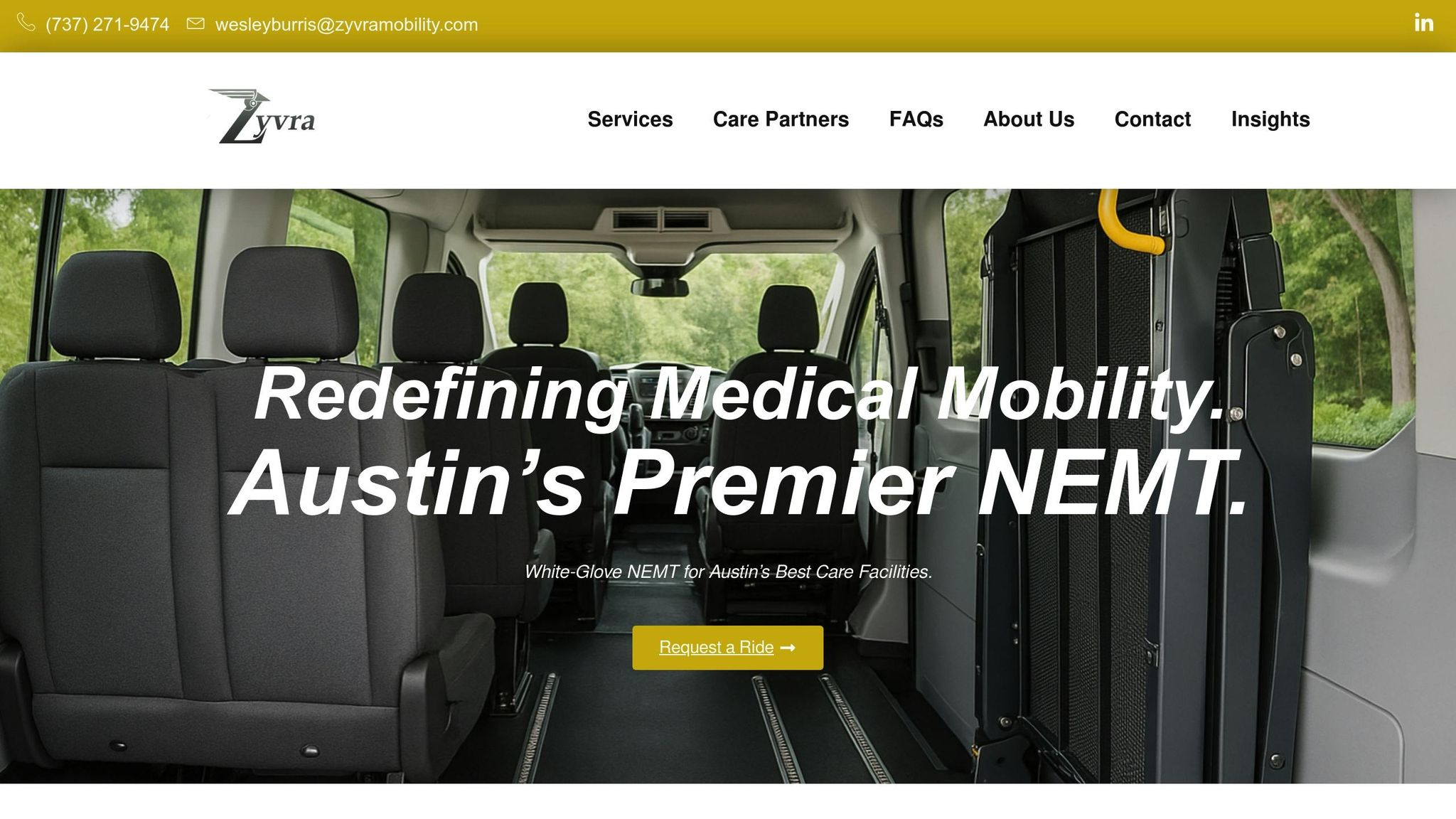
Operators such as Zyvra Mobility can tap into AI-driven tools to improve patient safety and streamline their operations. For instance, smart dispatch systems have proven their worth – AI-powered scheduling and routing have been shown to reduce pickup times by an average of 15%, directly enhancing on-time performance for medical appointments and hospital discharges. Some providers have even managed to downsize their dispatcher teams while maintaining the same trip volume.
AI also helps reduce no-shows by 25% through automated reminders, leading to better resource utilization. Integration with Electronic Health Records (EHRs) further simplifies operations by automating trip scheduling when appointments are made, eliminating manual data entry and reducing errors. Additionally, AI strengthens compliance by creating audit-ready trip logs complete with GPS data, timestamps, and service proof – essential for Medicaid claim approvals. One provider reported an increase in claim acceptance rates from 82% to 96% within the first year of adopting AI. These tools not only improve safety and reliability but also ensure providers meet strict regulatory standards. With these advancements in place, ongoing research promises to push NEMT services even further.
Future Research and Advancements in AI for NEMT
The next phase of AI in NEMT will focus on predictive patient risk scoring. By analyzing historical data, demographics, and clinical information, future systems will identify patients at higher risk of missing appointments or requiring special accommodations. Self-learning dispatch systems are another exciting development – these AI tools will continuously analyze completed trips to identify patterns in delays or cancellations, refining their algorithms to adapt to real-world conditions.
Emerging technologies like AI-integrated wearable monitors could enable real-time tracking of vital signs and automated emergency alerts. Meanwhile, advancements in autonomous vehicle technology and IoT-based vehicle diagnostics are on the horizon. However, for the foreseeable future, these innovations will likely operate within hybrid models that include human oversight. As AI becomes more ingrained in the healthcare ecosystem, these developments will elevate patient safety, improve service reliability, and position NEMT providers as essential contributors to population health initiatives and equitable care strategies.
Conclusion
AI is reshaping how Non-Emergency Medical Transportation (NEMT) services operate, setting new standards for efficiency and care. With measurable improvements like a 25% reduction in no-shows and a 30% drop in fuel consumption, AI tools are proving their worth in areas such as scheduling, route planning, compliance, and patient safety.
"AI isn’t replacing humans in healthcare – it’s empowering them to do more with less. For medical transport providers, this means better outcomes for patients, more efficiency for partners, and less stress for staff." – Suncore Transport
For providers like Zyvra Mobility, these technologies elevate patient care while ensuring compliance with CMS and Medicaid requirements. AI transforms manual processes into intelligent systems that adapt in real time – rerouting around traffic, assigning the right vehicle for specific needs, and creating audit-ready trip logs. The result? Fewer missed appointments, safer rides, and smarter resource allocation. These advancements not only streamline operations but also set a higher bar for patient care.
Looking ahead, the integration of predictive risk scoring, Electronic Health Records (EHR), and self-learning dispatch systems will further enhance NEMT services. Providers embracing these innovations will be better equipped to deliver timely, reliable transportation, ensuring that patients receive the care they depend on while improving overall community health outcomes. The future of NEMT is one where technology ensures every trip is safe, compliant, and impactful.
FAQs
How does AI enhance patient safety in non-emergency medical transportation (NEMT)?
AI brings a new level of safety to Non-Emergency Medical Transportation (NEMT) by analyzing real-time traffic, road conditions, and individual patient needs. This allows for more efficient route planning, minimizing delays and ensuring a safer, more comfortable ride – especially for patients using wheelchairs or stretchers.
With its advanced capabilities, AI also helps NEMT providers stay aligned with safety regulations while customizing services to suit each patient’s unique requirements. This combination results in dependable and secure transportation for medical appointments, rehab visits, or hospital discharges.
How does predictive maintenance improve safety and reliability in NEMT services?
Predictive maintenance uses AI-powered tools to keep an eye on vehicle performance, spot potential problems early, and plan repairs before a breakdown happens. By addressing maintenance needs ahead of time, this method helps prevent unexpected vehicle failures, ensuring safer and more reliable transportation for patients.
This proactive strategy doesn’t just cut down on downtime; it also helps reduce repair expenses and improves overall operational efficiency. For patients who depend on non-emergency medical transportation, predictive maintenance guarantees timely and secure rides to medical appointments and other crucial destinations.
How does AI help protect patient data in NEMT services?
AI strengthens the protection of patient data in NEMT services by utilizing HIPAA-compliant systems alongside advanced security measures. These measures include robust data encryption, stringent access controls, and routine security audits, all aimed at safeguarding sensitive information.
Moreover, AI-powered platforms work to reduce human errors and limit unauthorized access, providing a more secure and dependable framework for managing patient data.