

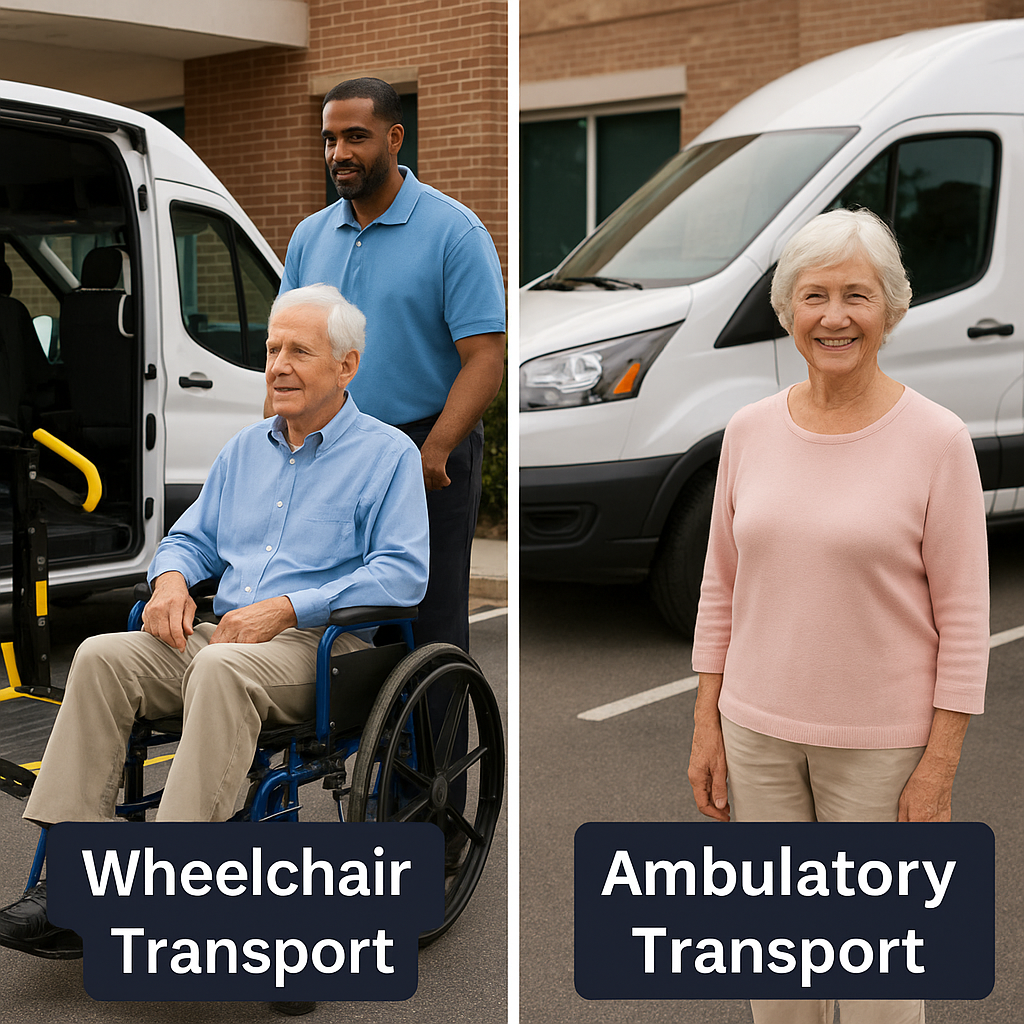
Wheelchair transport and ambulatory transport serve different mobility needs. Wheelchair transport accommodates patients who cannot transfer independently, while ambulatory transport is for those who can walk with minimal assistance.
Here’s what matters: choosing the wrong transport type can delay appointments, create safety risks, and increase costs. About 3.6 million Americans use wheelchairs, and many need specialized medical transport that standard vehicles can’t provide.
Key differences at a glance:
- Wheelchair transport uses vehicles with lifts or ramps for patients who remain in their wheelchairs
- Ambulatory transport provides assistance for patients who can walk and sit in regular vehicle seats
- Equipment needs differ significantly between the two service types
- Pricing varies based on vehicle requirements and staff training needed
Quick Comparison
| Feature | Wheelchair Transport | Ambulatory Transport |
| Patient Mobility | Cannot transfer independently | Can walk with minimal help |
| Vehicle Equipment | Lifts, ramps, wheelchair securement | Standard vehicle with handrails |
| Staff Requirements | Trained in wheelchair handling | Basic mobility assistance |
| Typical Use Cases | Power wheelchair users, severe mobility limitations | Elderly, recovering patients, vision impaired |
| Average Cost | Higher due to specialized equipment | Lower, comparable to ride services |
What Is Wheelchair Transport
Wheelchair transport moves patients who need to remain in their wheelchairs during the trip. The vehicle comes equipped with a hydraulic lift or ramp that raises the wheelchair into the vehicle.
This service isn’t just about having a bigger vehicle. The wheelchair gets secured with multiple tie-down straps to prevent movement during transit. Drivers receive specialized training in safe wheelchair handling and proper securement techniques.
Most wheelchair transport vehicles accommodate power wheelchairs, which can weigh up to 400 pounds with the patient. The floor space and ceiling height differ from standard vehicles to handle these dimensions.
Who Needs Wheelchair Transport
Patients who cannot transfer from their wheelchair to a regular car seat need this service. This includes:
- Power wheelchair users who depend on their chairs for positioning support
- Patients with severe arthritis or joint conditions making transfers painful
- Individuals recovering from hip or leg surgeries
- People with muscular dystrophy or similar progressive conditions
- Bariatric patients whose wheelchairs provide necessary support
Your doctor might specify wheelchair transport on the prescription if standing or pivoting poses medical risks. Some patients can walk short distances but lack the stamina for multiple transfers.
Wheelchair Transport Vehicle Features
Hydraulic lifts handle the weight and allow smooth entry without jarring movements. Platform lifts lower to ground level, eliminating the need for patients to navigate steps or steep ramps.
Inside the vehicle, four-point securement systems attach to the wheelchair frame at designated points. These prevent forward, backward, and side-to-side movement. Separate shoulder and lap belts secure the passenger.
Climate control systems maintain consistent temperature, which matters for patients with conditions affected by heat or cold. Non-slip flooring provides traction for wheelchairs with manual operation.
Some vehicles offer stretcher capabilities alongside wheelchair transport, providing flexibility for medical facilities that need both services.
What Is Ambulatory Transport
Ambulatory transport serves patients who can walk and sit in standard vehicle seats but need assistance getting to appointments. The vehicles look similar to regular cars or vans but have specific features for passenger safety.
Staff members provide door-to-door service, which means helping patients from their residence to the vehicle and from the vehicle into the medical facility. This isn’t just a ride—it’s supervised transport with trained personnel.
These services bridge the gap between standard ride-sharing and full medical transport. Patients maintain their independence while getting the support they need.
Who Benefits from Ambulatory Transport
This service works for patients with:
- Mild to moderate mobility challenges who tire easily
- Vision impairments requiring guidance in unfamiliar locations
- Recent hospital discharges with temporary weakness
- Chronic conditions requiring frequent dialysis or chemotherapy visits
- Cognitive concerns where a familiar driver provides reassurance
Many seniors use ambulatory transport even when they could technically drive themselves. The service eliminates parking hassles, reduces anxiety about navigating traffic, and ensures they arrive on time.
Ambulatory Vehicle Accommodations
Vehicles include grab bars near entry points for stability during entry and exit. Step stools or running boards reduce the height difference between ground and seat level.
Seats position lower than standard SUVs but higher than sports cars, creating the easiest transfer height. Drivers clear a path from the vehicle to the entrance, watching for obstacles like ice, uneven pavement, or curbs.
Staff wait with patients until medical facility staff come to escort them inside. After appointments, drivers help patients back to the vehicle and ensure they’re safely inside their residence before leaving.
Comparing Safety Standards
Both transport types follow specific safety protocols, but the requirements differ based on patient needs.
Wheelchair Transport Safety Protocols
Securement takes three to five minutes per wheelchair when done correctly. Drivers inspect tie-down equipment before each shift and verify proper attachment points on wheelchairs.
Federal Motor Carrier Safety Administration (FMCSA) regulations mandate specific securement patterns. Front tie-downs angle forward at 30-45 degrees, while rear tie-downs angle backward. This geometry prevents the wheelchair from tipping during sudden stops.
Drivers complete specialized training covering:
- Weight distribution and balance points
- Proper lift operation and emergency procedures
- Communication with patients who have limited mobility
- Wheelchair types and their specific securement requirements
Ambulatory Transport Safety Measures
Drivers assess patient mobility before each trip.